It must be springtime in AK: The ravens are courting.
Lately there've been a lot of pair-flights in my neighborhood, little duos of ravens wheeling and dipping over the treetops, flying their swirling, romantic, aerobatic courtship displays, grace on the wing. This is, for me, an unmistakable sign of spring here. Even though I have that brain perversion that makes me think spring happens about the end of January, I think nearly everyone would agree with me that the juice is rising now. There's daylight both on my way to and on my way home from work, I've decreased the heat in my house, and things buried for months in my back yard are starting to emerge from under the snow.
Mind you, at a casual glance, one might be decoyed: It's the season of brown.
Summer here is unrelentingly green, and fall is often gloriously golden. Winter, of course, is white - at least in the daytime - bracketed at dawn and dusk with the most glorious shades of red and gold and peach and violet. But early spring (which in my mind is mid-spring) tends toward brown: the snow is disappearing, but the green-up hasn't started yet. Even MY twisted little brain can't make it look green... yet. That's coming - along with the return of the swans, the swift bullet-flights of the ducks, the evocative calls of the cranes and the haunting songs of loon and grebe. Then my lake will be open water, glimmering in the long light of summer, a thing of peace to be found, always, at the slightest glance out my windows.
I like living on the water. There was a time when I lived literally ON the water, in a boat: a 40-foot 1960 Chris-Craft yacht, to be exact. Now I live more metaphorically on the water, in the sense that my house is situated on a peninsula into a lake. Back in vet school, though, I had to make do with an irrigation ditch.
I lived on a property that had a small acreage, two frontages, several mature apple and cherry trees, a small house, a detached garage (which I rented out to a friend) and an irrigation ditch running through the fenced pasture area. Mind you, this was really quite pleasant and much prettier than it probably sounds. I'll grant you than in the winter the ditch was dry, which wasn't as pretty, but did have one advantage: It allowed my mustang mare to go across the ditch to a part of the pasture that she would not dare approach in the summer. The thoroughbreds would cross at will, fording the fast-flowing water without the slightest concern, but the mustang would not even consider this behavior, no matter which side her best friends and pasture-mates were on.
The down-side of the winter-dry ditch became apparent one day when a trio of adolescent boys came trundling down the ditch, evidently using it as their own personal highway, without regard to property lines or trespassing. They appeared unexpectedly from under the bridge that spanned the ditch where it passed under the adjacent road. I happened to be outside at the time with a classmate, Jean. We were treated to the experience of seeing all three horses in my pasture startle and bolt at the appearance of the boys. They ran down the fence-line, two of them crowding my mustang against the fence. Trapped tight against the wire, she leaped over it into the neighboring pasture, taking down the top wire as she did.
I bolted after the horses, hopping the remaining wire to catch up my mustang and inspect for damage. Jean, who had at one time been a Sheriff's deputy, took several brisk strides toward the ditch, calling in a deep, authoritative voice, "You kids are trespassing! Get off of this property!" It was quite a transformation: Jean is normally soft-spoken and rather gentle in her body language, and all of a sudden she's striding along like a colossus out to bust some heads, and her voice had dropped an octave and risen in volume by a factor of ten. The kids all leaped a half a foot in the air and turned, scrambling, to run back the way they had come.
I never saw them again. Quelle suprise. Not.
Meanwhile, my mustang, blowing and snorting, eyes wide and ears swivelling madly to catch any hint of threat, consented to pause by the far fence of the neighbor's pasture as I approached her. She held her head high and tense, surveying the ditch, but when the boys disappeared under the bridge she dropped her head a little and allowed me to sort through her dense winter coat for the source of the blood I could see streaked against her grey dapples. Nothing too bad: three parallel cuts, not quite full-thickness through her skin. Lucky it wasn't one of the two thin-skinned thoroughbreds, in which case I was fairly certain I'd be doing stitches.
Ah, well. That was the worst of the things that came of having an irrigation ditch run through it.
Most of the time it was rather a delight to have the ditch there. It meant I didn't have to worry about water if I decided to empty out and scrub the stock tank, and it was home to a family of muskrats and one of ducks. It was a delightful thing, of a morning or an evening, to go down and sit by the ditch with my notes and perhaps a cup of coffee, studying and sipping and enjoying the quiet sound of flowing water and the antics of the wildlife... well, sometimes studying and sometimes not. The muskrats would generally disappear when I first arrived, only to venture forth again a few minutes later, after I had failed to do anything frightening. They would swim up and down the ditch, sometimes emerging on the far bank, sometimes paddling along against the current, diving now and again with a little flash of their long bare tails. Once in a while one of the babies would climb out on the bank and huddle there, peering nearsightedly at me and sniffing the air for a while - until my evident boringness caused them to lose interest and they disappeared amongst the grasses on the bank, or slid seamlessly back into the water.
Most of the time, if I was sitting by the ditch, Cassie the mustang mare would come join me. Sometimes she would nuzzle at my coffee cup, attempting to taste the contents, or else sniffing deeply and then turning her upper lip up to funnel the aroma into her nostrils. Sometimes she would riffle softly through my hair with her thick velvety lips, blowing and snuffling gently at my skin, twitching her upper lip side-to-side to give me a companionable scratch. Sometimes she would lay down nearby, taking advantage of my guardianship to have a little lie-down. Sometimes she would simply stand next to me, head drooping companionably to the level of mine, her eyelids half-mast and blinking sleepily. Every once in a while she would poke her nose over my shoulder, peering at my notes and trying to turn the pages with her nose. She was insatiably curious, and relentlessly social - both useful traits for a wild horse, I imagine. Having been caught at approximately a year of age, Cassie had had the lessons of the wild to reinforce her own natural temperament - a lucky thing for me, given the number of times she devised a new means of escaping from the pasture. She was always to be found a few pastures down, visiting the nearest neighbor horses, but the moment I showed up she would turn away from them, bright-eyed with interest, to walk up to me. You could almost see her thinking "Hi! What are YOU doing here? Got anything to eat?"
Most fortunately, I could walk Cassie back home without benefit of halter or rope. All that was necessary was to reach under her throat-latch and pinch about 18 of her mane-hairs between my thumb and forefinger. This seemed sufficient lead by which to convince her to walk home with me, the other horses trailing in her wake. As she was always fascinated with whatever boring thing I was up to - and there was every chance she might be rewarded with food for accompanying me - she was more than willing to walk along home with me. I sometimes wondered what passing motorists thought of this odd little parade: Me (usually dishevelled, having been woken out of a sound sleep at 6 in the morning by some helpful stranger pounding on my door and yelling "Hey! Your horses are out!"; walking at my right shoulder, a sturdy and beautifully dappled grey mare wearing a bright, interested expression but nary a halter nor rope nor anything else; and two chestnut geldings clopping happily along single-file in our wake.
The pasture was a peaceful refuge for me on many an evening when I'd driven my brain hard all day and needed a little mental break before putting it back to work for the evening's studying. Quite often my little old dog Merrik - then 12 years old and missing one eye as a consequence of cancer, but still tough and active and otherwise bursting with health and energy - would accompany me out into the pasture, wandering around and sniffing things, sifting through the feed dishes for stray bits of sweet feed, milling peacefully amongst the horses, all of whom tolerated her presence without the slightest animosity. It was a lovely, restful, soothing ritual, often repeated throughout vet school.
Except for the day Merrik saw the ducks.
Merrik was pathologically fearful of water. Like many dogs, she dreaded being bathed, and spent the entire time attempting to escape the tub (or sink, or wherever I was bathing her). She was a relatively small dog (only 20 pounds) but she had the magical ability to gain twice her usual weight - not to mention several extra limbs - whenever I tried to pick her up to put her in the tub. Outside, she would skirt all but the smallest puddles. She would certainly go up to the irrigation ditch for a drink, but she was careful to place her front feet on the bank where she could balance herself securely without risk of getting wet.
One day, though, while walking around the pasture with me, Merrik happened to notice the duck family on the waters of the irrigation ditch. Well, this is an enticement not to be ignored: There, right in front of her, is a large mallard with four or five babies trailing in her wake. Who could resist chasing that?
Merrik takes off, growling low in her throat, darting at a shallow angle toward the ditch. The duck babies immediately begin paddling rapidly for the far shore. The mother duck begins swimming fast against the current, but hugging the near shore to decoy the dog away from her babies as Merrik (ignoring me as I try to call her off) closes in. At the last minute, the babies all having made the safety of the far bank, the mother duck churns it into overdrive, angling sharply across the water to follow the babies. At the same moment, Merrik - focused now on nothing in life but that duck - makes her leap.
She missed, of course.
The rest was like a cartoon. Merrik, on hitting the dread miasma of (gasp!) water, leaps strait up in the air. It's like watching a rocket launch, spray flying everywhere as she explodes out of the drink. Somehow, about two and a half feet above the surface, she manages to change direction and comes down on the bank rather than falling back into the ditch. This is rather a relief to me, because the laminar flow in the ditches - deceptively smooth and calm on the surface - is swift-flowing and powerful under the surface, capable of drowning adult humans. Apparently the shock of landing in water is enough to completely short-circuit Merrik's brain, and she races madly about the pasture for the next ten minutes, making wide, swift loops and zigzags and barking incessantly the entire time. Meanwhile I laugh helplessly, unable to catch my breath long enough to call her to me to reassure her, and slightly unhinged by the relief of not having my beloved dog sucked into the undertow to her death. The horses look on in bemusement, their heads turning to watch Merrik's progress as she criss-crosses the pasture at top speed. Cassie, excited by the activity, trots a few strides, tossing her head, but then stops again to watch the show.
Eventually Merrik outruns her shock and horror and slows down, and I am able to catch my breath and call her to me. She is panting and muddy, and her one remaining eye is wild with excitement. I take pity on her and decide not to bathe her; instead we hang out under the apple trees until she dries and I brush the mud out of her coat.
Merrik is many years in her grave - she lived to be fourteen, and the four years we had following her diagnosis and treatment for cancer were the best of her life. We did everything together, every fun thing I could think of for a person and a tough little terrier mix dog to do together. I suppose I will always miss her; but I can't help but smile when I think of her. She was the perfect sidekick to me for many years, and (bless her heart) saw me through vet school and into internship. She was everything charming and delightful and engaging and sweet, everything tough and cheerful and good-hearted and adorable a dog could be. She made me laugh more times than I could ever count, and makes me smile to this day whenever I think of her. I don't think I ever saw a dog more conscious of her dignity, yet more willing to abandon it when the opportunity presented itself. I'll have that afternoon always in memory: the sun slanting golden in the late afternoon, the green of the pasture, the muddy brown of the water, dappled with sun... the horses wandering about, copper and smoke drifting over the grass, and my little silver-black dog, racing wild-eyed through the mix, barking hysterically the while.
It might not have been quite as good as having a river run through it.... but the irrigation ditch was a pretty decent substitute.
Showing posts with label vet school. Show all posts
Showing posts with label vet school. Show all posts
Wednesday, February 24, 2010


Monday, September 28, 2009
The Red Hand of Death (And Other Ways to Stay Sane During Vet School)
Vet school is a stressful gig. It's not just the responsibility of it, the knowledge that you are undertaking to go out and save lives, do surgery, make tricky medical diagnoses; undertaking to be the expert, to have people rely on you for help in matters of life and death. It's not just the astonishingly fast pace or the intense workload or the massive amount of information and skills you are trying to master. It's not just the expense of it, the long hours and the early realization that, rather than floating somewhere near the top of your class, an academic over-achiever, you are suddenly average: EVERYONE in your class is an academic over-achiever and ALL of them are from the tops of their classes - and at least half of them (and probably more) were better students than you were.
No, there's also the sneaking suspicion that your admission was a dreadful administrative error, and that you don't really belong here. This feeling will be emphatically underscored by the realization that the stunning girl who sits next to you - who is beautifully made-up and has her long strait hair perfectly curled, who has a husband and a house and a job.... this girl is not just smart enough to get into vet school, but she's SO smart she also has time to manage a full life AND look like that. Every day.
That's when you're pretty certain you're sunk.
Maybe it's not a big surprise that I went a bit frantic on the studying the first semester. We had an exam every 10 days, because if they stretched them out further, the amount of material to master was just too vast to be contained within one exam.
Now, the upperclassmen and the faculty were all well aware of the fact that the first exam of vet school was the most stressful of all of them - until it came time to take the National Board Exam and the Clinical Competency Test in senior year (plus or minus a state board exam, depending on the state in which you proposed to work). It's tradition that an outgoing Freshman - now a newly-minted sophomore - "adopted" a "little sib": an incoming and somewhat petrified freshman. In my case, I had my regular big sib - who, on the morning of the first exam, brought me a plate of home-made snicker doodles and a nice encouraging card, which was bright and cheerful and full of moral support - but I also had my neighbor's big sib, a very kindhearted girl who had met me via a work-study situation and to some degree taken me under her wing. She brought both of us - me and the kind, funny, intelligent and intimidatingly beautiful girl who sat next to me, who was her ACTUAL little sib - a new and freshly-sharpened #2 pencil, a brand-new eraser, and a petri dish of m&m's, labelled "m&m culture, eat on [date of exam]". My neighbor also got a few extra goodies, but it seemed her big sib didn't want to leave me out. Isn't that sweet?
Next we are all ushered, trembling, sleep-deprived and sweaty-palmed, into the lecture hall, where they are to pass out our exam papers and tell us the rules (the exam being half written, half practical). There is a strange murmuring noise, which you quickly realize is composed of 131 freshman muttering last-minute aides-memoirs to themselves or their neighbors. The professors proctoring the exam are on the lecture stage as the second hand sweeps away the remaining time before the exam. Suddenly it's 8:00. You can almost hear a hundred and thirty-one hearts skip a beat in synchrony.
The lab coordinator gets up to tell us how the practical stations are set up in the lab: there are no more than four students allowed per station at any one time, though we're allowed to go back and forth between stations as many times as we like, within the 4 hours we are allotted to take the exam. We are also welcome to take the exam sitting in the lecture hall or go back to our cubicles and take it sitting at our desks, or anywhere else inside the building, as the honor code applies: we are expected not to cheat. (Although an honor board exists - a group of students who self-police their peers, with advice and supervision from a professor - it is rarely needed over the next 4 years, and never is a student actually found to have been cheating, at least in my vet school class).
Now there is a slight pause, and the lab coordinator tells us a joke. A pretty good one, getting roars of laughter. A bunch of students shuffle in at one side of the lecture stage; they are upperclassmen, and they put on a skit to loosen us up. It's pretty funny - although to this day everything that happened before that exam is a blur to me, and I have not the faintest recollection what the skit was about. What I do remember is laughing so hard I was nearly crying, while one part of my brain stood off to the side, looking at me and saying: Man. You are REALLY stressed out. Get a grip on yourself.
But the joke and the skit do their jobs: I am feeling cheerful and upbeat and a bit more relaxed as I start my exam in my cubicle, with my snicker doodles and my m&m culture, looking at a picture of my pony I have taped to the wall. (Okay, it's one of the racehorses I groomed right before I came back to school, but you get the idea.)
After the first exam, when I realise that I did well, I start to relax just a little. Maybe it wasn't a huge administrative error after all and I really DO belong here. I don't let up on the work, but I'm not so freaked out any more, since I've proven to my personal satisfaction that I can in fact handle the material, as long as I apply myself.
Still: it's a big deal, being in vet school, and I never want someone's animal to pay for me not paying enough attention in school, so like my vet school brethren, I work hard. Which means that we have to play hard - and we do.
At least some students go out dancing every time an exam falls on a Friday night, as there are no classes the next morning. I am amongst those who find this relaxing, and I'll dance til I fall over. Not well, mind you, but with great enthusiasm. Then there are various FACs (Friday Afternoon Clubs) at various bars and eateries around town, which vet students are adept at ferreting out, as many offer free or half-price appetizers and cheaper drinks from (say) 5 to 7 p.m. on Friday afternoons. There's my usual Saturday coffee date with my friend SF, at which we would vent and commiserate. We never said where we would meet; one of us would call the other and it would be:
"You want to meet?"
"Sure, what time?"
"How about noon?"
"Okay, see you there!" [click].
Then we would meet at noon, having never specified WHERE we were meeting or what for. It didn't occur to me until senior year that the only thing we ever specified was the time.
Sometimes I would take out my little mustang mare (or my thoroughbred mare, or one of the horses I boarded in my pasture for extra money) and ride in the beautiful old cemetery across from my house. Sometimes I would go for a walk or a run in the same cemetery. Sometimes I would just sit and listen to music, or watch a movie or a little TV whilst meditatively knitting or spinning yarn, or play silly games with my dog. Sometimes I'd just sit and stare out my window, or go down by the irrigation ditch running through my property and watch the ducks and muskrats playing in the water. I also developed a few culinary hobbies, the B list: making bread, beer and biscotti (all of which had the significant advantage that you could eat or drink the results of your stress-relieving hobby, providing further stress relief.) Sometimes I would write - can't seem to help that, no matter the circumstances - and sometimes I'd get out my pad and sketch, or just draw pictures in the margins of my notes.
In vet school I was also a hiking fool. I had a ratty old Dodge Dart, which half the time had to be started by arcing two poles on the starter with the assistance of large slotted kitchen spoon, but which limped me through the first couple of years of vet school. I took my dog hiking probably at least five times a week for the first three years - less often the last year, as the workload increased, but even then we probably made about three times a week or more (except for the month I spent on the ICU rotation).
But maybe the single most important thing that kept me sane through the first three years of vet school was the discovery of racquetball.
This was introduced to me by MT, she of San Juan rafting fame. For 7 weeks of the first semester of vet school (for me; she was finishing her Master's degree) we had a weight-training class three days a week and would warm up by playing racquetball for an hour or more first. Then we'd do our weight training and then we'd walk to Pescado Bay for fish tacos afterwards. Naturally MT was a much better player than I was, but by the time she graduated, I was hooked. Not because I was so good at it: more because it just felt so good to hit something.
So I developed other friends to play racquetball with, and was on the courts at least 5 days a week the first two years of vet school (during which we were up-campus and within walking distance of the students-only rec center), and on a slightly slower schedule for the third year, when our classes moved down-campus to the teaching hospital. I did have two unfortunate events associated with my racquetball obsession: One was that I tore my calf muscles badly on the court one day early in our sophomore year and was laid off for three weeks; that made me nearly crazy with restlessness, and to this day that calf has never been quite the same. And the other was that, consequent to my years making my living at the end of a pitchfork, I had tendinitis in both wrists. This made for a certain amount of strain on my right wrist during play, with the consequence that sometimes, as my hand grew slick with sweat, the racquet would spin in my grip, ruining a shot.
Well. I can't have THIS. I need to hit the ball so hard I split it along its seam. Need to, I tell you.
So I went shopping for a glove of some kind, something that would keep its grip no matter how sweaty my hand got. But naturally I didn't need TWO gloves, since racquetball is a one-handed game. To my annoyance, I could find goggles and balls and racquet covers, sweat bands and court shoes and all manner of workout clothing - but nary a racquetball glove to be found. Not one.
After much poking about I realised that golf gloves come as a single glove. Well. This looks promising.
So I tried on all kinds of different golf gloves of various sizes and makes, until I found the one that fit me the way I wanted. It was thin and light and didn't ruin my feel of the racquet, but it was made of leather that would absorb the sweat and would, if anything, become stickier if the sweat soaked through the palm. Perfect.
The first day I tried it out I was playing with a male classmate, C. He had thick curly brown hair and smiling dark eyes, and in some way reminded me of both my brothers - the curly dark hair and twinkly chocolate eyes of one, and the teasing demeanor and bratty-younger-brother spunk of the other. He was not so very much taller than me - perhaps six or seven inches - but he was significantly more athletic - well, or at least looked it, with a diver's build and a general lazy ease of motion.
We get on the court and I unzip my racquet cover, taking out my golf glove and pulling it on. It just so happens that this glove, the one that fit me just right, is bright red. C takes one look at it and starts laughing.
"What is that?" he asks me.
"The Red Hand of Death," I tell him with narrowed and menacing eye, trying not to grin. For some reason this makes C laugh all the harder. (Hmm, I can't think why THAT would be). On the other hand - the Red Hand of Death hand, no doubt - I beat him two games to one that day... maybe because he was laughing at me the whole time.
I'm telling you: It doesn't do to laugh at The Red Hand of Death.
Nowadays I find my stress relief in some ways differently, and some ways similarly. I no longer have a horse, and my gym does not have a racquetball court (although there is a gym in town that does, the fees have gotten ridiculous, and I have no partners anymore, so it hardly seems worth it.) I traded making beer for making wine, and baking for making kefir and roasting lamb. I still play silly games with my dogs, of course, although some of those games are a bit more serious - working sheep, for instance. There is less regular TV and more PBS and movies, although music and staring out my windows are still good. I do less sketching and more photography, less hiking and more flying, but I still meet friends for coffee. I have no patience for spinning anymore - in part because the minute I turn my back on it some Border collie snatches the end of the yarn and runs all over the house with it, unreeling it madly and tangling it in a giant spider web upstairs and down - but I still like to knit and crochet, especially while watching TV... it seems less wasteful somehow if I'm making something at the same time. And of course... I still write. I still can't help that. It's almost a compulsion.
These things do me fine, for the most part. Every once in a while, though, when I've had a particularly trying day I can feel a little itch in my palm, and I think: I wonder if I could get away with wearing it to work... The Red Hand of Death.
No, there's also the sneaking suspicion that your admission was a dreadful administrative error, and that you don't really belong here. This feeling will be emphatically underscored by the realization that the stunning girl who sits next to you - who is beautifully made-up and has her long strait hair perfectly curled, who has a husband and a house and a job.... this girl is not just smart enough to get into vet school, but she's SO smart she also has time to manage a full life AND look like that. Every day.
That's when you're pretty certain you're sunk.
Maybe it's not a big surprise that I went a bit frantic on the studying the first semester. We had an exam every 10 days, because if they stretched them out further, the amount of material to master was just too vast to be contained within one exam.
Now, the upperclassmen and the faculty were all well aware of the fact that the first exam of vet school was the most stressful of all of them - until it came time to take the National Board Exam and the Clinical Competency Test in senior year (plus or minus a state board exam, depending on the state in which you proposed to work). It's tradition that an outgoing Freshman - now a newly-minted sophomore - "adopted" a "little sib": an incoming and somewhat petrified freshman. In my case, I had my regular big sib - who, on the morning of the first exam, brought me a plate of home-made snicker doodles and a nice encouraging card, which was bright and cheerful and full of moral support - but I also had my neighbor's big sib, a very kindhearted girl who had met me via a work-study situation and to some degree taken me under her wing. She brought both of us - me and the kind, funny, intelligent and intimidatingly beautiful girl who sat next to me, who was her ACTUAL little sib - a new and freshly-sharpened #2 pencil, a brand-new eraser, and a petri dish of m&m's, labelled "m&m culture, eat on [date of exam]". My neighbor also got a few extra goodies, but it seemed her big sib didn't want to leave me out. Isn't that sweet?
Next we are all ushered, trembling, sleep-deprived and sweaty-palmed, into the lecture hall, where they are to pass out our exam papers and tell us the rules (the exam being half written, half practical). There is a strange murmuring noise, which you quickly realize is composed of 131 freshman muttering last-minute aides-memoirs to themselves or their neighbors. The professors proctoring the exam are on the lecture stage as the second hand sweeps away the remaining time before the exam. Suddenly it's 8:00. You can almost hear a hundred and thirty-one hearts skip a beat in synchrony.
The lab coordinator gets up to tell us how the practical stations are set up in the lab: there are no more than four students allowed per station at any one time, though we're allowed to go back and forth between stations as many times as we like, within the 4 hours we are allotted to take the exam. We are also welcome to take the exam sitting in the lecture hall or go back to our cubicles and take it sitting at our desks, or anywhere else inside the building, as the honor code applies: we are expected not to cheat. (Although an honor board exists - a group of students who self-police their peers, with advice and supervision from a professor - it is rarely needed over the next 4 years, and never is a student actually found to have been cheating, at least in my vet school class).
Now there is a slight pause, and the lab coordinator tells us a joke. A pretty good one, getting roars of laughter. A bunch of students shuffle in at one side of the lecture stage; they are upperclassmen, and they put on a skit to loosen us up. It's pretty funny - although to this day everything that happened before that exam is a blur to me, and I have not the faintest recollection what the skit was about. What I do remember is laughing so hard I was nearly crying, while one part of my brain stood off to the side, looking at me and saying: Man. You are REALLY stressed out. Get a grip on yourself.
But the joke and the skit do their jobs: I am feeling cheerful and upbeat and a bit more relaxed as I start my exam in my cubicle, with my snicker doodles and my m&m culture, looking at a picture of my pony I have taped to the wall. (Okay, it's one of the racehorses I groomed right before I came back to school, but you get the idea.)
After the first exam, when I realise that I did well, I start to relax just a little. Maybe it wasn't a huge administrative error after all and I really DO belong here. I don't let up on the work, but I'm not so freaked out any more, since I've proven to my personal satisfaction that I can in fact handle the material, as long as I apply myself.
Still: it's a big deal, being in vet school, and I never want someone's animal to pay for me not paying enough attention in school, so like my vet school brethren, I work hard. Which means that we have to play hard - and we do.
At least some students go out dancing every time an exam falls on a Friday night, as there are no classes the next morning. I am amongst those who find this relaxing, and I'll dance til I fall over. Not well, mind you, but with great enthusiasm. Then there are various FACs (Friday Afternoon Clubs) at various bars and eateries around town, which vet students are adept at ferreting out, as many offer free or half-price appetizers and cheaper drinks from (say) 5 to 7 p.m. on Friday afternoons. There's my usual Saturday coffee date with my friend SF, at which we would vent and commiserate. We never said where we would meet; one of us would call the other and it would be:
"You want to meet?"
"Sure, what time?"
"How about noon?"
"Okay, see you there!" [click].
Then we would meet at noon, having never specified WHERE we were meeting or what for. It didn't occur to me until senior year that the only thing we ever specified was the time.
Sometimes I would take out my little mustang mare (or my thoroughbred mare, or one of the horses I boarded in my pasture for extra money) and ride in the beautiful old cemetery across from my house. Sometimes I would go for a walk or a run in the same cemetery. Sometimes I would just sit and listen to music, or watch a movie or a little TV whilst meditatively knitting or spinning yarn, or play silly games with my dog. Sometimes I'd just sit and stare out my window, or go down by the irrigation ditch running through my property and watch the ducks and muskrats playing in the water. I also developed a few culinary hobbies, the B list: making bread, beer and biscotti (all of which had the significant advantage that you could eat or drink the results of your stress-relieving hobby, providing further stress relief.) Sometimes I would write - can't seem to help that, no matter the circumstances - and sometimes I'd get out my pad and sketch, or just draw pictures in the margins of my notes.
In vet school I was also a hiking fool. I had a ratty old Dodge Dart, which half the time had to be started by arcing two poles on the starter with the assistance of large slotted kitchen spoon, but which limped me through the first couple of years of vet school. I took my dog hiking probably at least five times a week for the first three years - less often the last year, as the workload increased, but even then we probably made about three times a week or more (except for the month I spent on the ICU rotation).
But maybe the single most important thing that kept me sane through the first three years of vet school was the discovery of racquetball.
This was introduced to me by MT, she of San Juan rafting fame. For 7 weeks of the first semester of vet school (for me; she was finishing her Master's degree) we had a weight-training class three days a week and would warm up by playing racquetball for an hour or more first. Then we'd do our weight training and then we'd walk to Pescado Bay for fish tacos afterwards. Naturally MT was a much better player than I was, but by the time she graduated, I was hooked. Not because I was so good at it: more because it just felt so good to hit something.
So I developed other friends to play racquetball with, and was on the courts at least 5 days a week the first two years of vet school (during which we were up-campus and within walking distance of the students-only rec center), and on a slightly slower schedule for the third year, when our classes moved down-campus to the teaching hospital. I did have two unfortunate events associated with my racquetball obsession: One was that I tore my calf muscles badly on the court one day early in our sophomore year and was laid off for three weeks; that made me nearly crazy with restlessness, and to this day that calf has never been quite the same. And the other was that, consequent to my years making my living at the end of a pitchfork, I had tendinitis in both wrists. This made for a certain amount of strain on my right wrist during play, with the consequence that sometimes, as my hand grew slick with sweat, the racquet would spin in my grip, ruining a shot.
Well. I can't have THIS. I need to hit the ball so hard I split it along its seam. Need to, I tell you.
So I went shopping for a glove of some kind, something that would keep its grip no matter how sweaty my hand got. But naturally I didn't need TWO gloves, since racquetball is a one-handed game. To my annoyance, I could find goggles and balls and racquet covers, sweat bands and court shoes and all manner of workout clothing - but nary a racquetball glove to be found. Not one.
After much poking about I realised that golf gloves come as a single glove. Well. This looks promising.
So I tried on all kinds of different golf gloves of various sizes and makes, until I found the one that fit me the way I wanted. It was thin and light and didn't ruin my feel of the racquet, but it was made of leather that would absorb the sweat and would, if anything, become stickier if the sweat soaked through the palm. Perfect.
The first day I tried it out I was playing with a male classmate, C. He had thick curly brown hair and smiling dark eyes, and in some way reminded me of both my brothers - the curly dark hair and twinkly chocolate eyes of one, and the teasing demeanor and bratty-younger-brother spunk of the other. He was not so very much taller than me - perhaps six or seven inches - but he was significantly more athletic - well, or at least looked it, with a diver's build and a general lazy ease of motion.
We get on the court and I unzip my racquet cover, taking out my golf glove and pulling it on. It just so happens that this glove, the one that fit me just right, is bright red. C takes one look at it and starts laughing.
"What is that?" he asks me.
"The Red Hand of Death," I tell him with narrowed and menacing eye, trying not to grin. For some reason this makes C laugh all the harder. (Hmm, I can't think why THAT would be). On the other hand - the Red Hand of Death hand, no doubt - I beat him two games to one that day... maybe because he was laughing at me the whole time.
I'm telling you: It doesn't do to laugh at The Red Hand of Death.
Nowadays I find my stress relief in some ways differently, and some ways similarly. I no longer have a horse, and my gym does not have a racquetball court (although there is a gym in town that does, the fees have gotten ridiculous, and I have no partners anymore, so it hardly seems worth it.) I traded making beer for making wine, and baking for making kefir and roasting lamb. I still play silly games with my dogs, of course, although some of those games are a bit more serious - working sheep, for instance. There is less regular TV and more PBS and movies, although music and staring out my windows are still good. I do less sketching and more photography, less hiking and more flying, but I still meet friends for coffee. I have no patience for spinning anymore - in part because the minute I turn my back on it some Border collie snatches the end of the yarn and runs all over the house with it, unreeling it madly and tangling it in a giant spider web upstairs and down - but I still like to knit and crochet, especially while watching TV... it seems less wasteful somehow if I'm making something at the same time. And of course... I still write. I still can't help that. It's almost a compulsion.
These things do me fine, for the most part. Every once in a while, though, when I've had a particularly trying day I can feel a little itch in my palm, and I think: I wonder if I could get away with wearing it to work... The Red Hand of Death.
Thursday, August 27, 2009
The Amazing Dr. B
Back in the day, I groomed racehorses for a living. This was an excellent job in many ways, not least of which being that I got paid decent money to be in fabulous shape. But I also learned my way around a wheelbarrow and developed a useful deftness at setting wraps on the highly valuable legs of my charges. I got so I could pitch manure accurately from the back of a stall into a wheelbarrow parked in the stall door, balance 7 bales of hay on a barrow and hop it over the sill of a barn door without dumping bales all over the shed row, pick out all four feet speedily and well without having to move from the left side of the horse, and any number of other useful things, such as how not to accidentally flip a rearing horse, how to carry two full five-gallon buckets of water rapidly down the barn aisle without spilling any, and (less usefully) how to comb pretty patterns into your horse's rump hair so she looks spiffy going to the post.
One of the useful things about being pretty handy with a pitchfork was that, during vet school, I made extra money mucking out the horse barns at the hospital. This was a different proposition in some ways than racehorse grooming - for one thing, there were a lot more stalls, and for another, there was no grooming involved. Moreover, mucking out happened in the afternoon and evening, rather than before the crack of dawn, and usually the horses were still in the stalls, rather than out breezing at the track. The pace was slower in that sense - I didn't have to get the stall mucked, the buckets hung, the next horse brushed and tacked, and the next stall started by the time the first horse came back from the track, steaming and blowing and needing a fast bath and a good cool-down. On the other hand, there were a lot more stalls to get through. Moreover, instead of pitching the stalls out into a wheelbarrow stationed in the doorway to the stall, the straw and manure had to be pitched over the top of the wall into a dumpster that was wheeled down the shed rows as we moved from stall to stall. It took a little while to develop speed and accuracy with this technique, but before long I found the rhythm of it.
This job lasted only during my junior year; in senior year there was really no time for that, as I often had rotations in the evening, or at night, or extremely early in the morning. However, I learned a little about the rhythm of medicine in the barn; we worked, of necessity, around senior vet students and clinicians doing treatments and taking in late cases. I, at least, got a sense of the clinicians; which ones were even-tempered, which were more fiery, which ones were so deeply intimidating that they scared the living crap out of the students.
Even though I tracked small animal - meaning I took the majority of my senior-year rotations in small animal medicine and surgery - I did do some equine rotations. This was always fun; equine ambulatory was like an all-day field trip, going from farm to farm, taking X-rays, stitching things up, drawing blood, treating colics, checking on delicate foals. I also did an equine anesthesia rotation (scary and exciting, but sometimes very sad), and an equine medicine rotation. This was run by Dr. B.
Dr. B amazed me at the very start of junior year. I was walking down the hall one day, minding my own business, and he happened to be ambling toward me down the hall. Dr. B looks like an old farm boy: Tall, loose-limbed but sturdy, grey hair buzzed down in a short crew cut, and possessed of twinkly grey eyes surrounded by lines earned through laughing and squinting into the sun, set in a square, good-natured face. All his visible skin was burned to a deep ruddy bronze, from the back of his neck to his broad, capable hands. He was of indeterminate age, but I assumed he was somewhere in his 50's at the time, and he looked - and was - entirely amiable. But on that day, his customary pleasant schoolboy grin was replaced for a moment with a frown of concentration. Seeing me (for the first time in my memory) from the end of the hall, he narrowed his eyes for a moment and then called me by name, startling me to a standstill.
"Did I get that right?" he asked.
"Well, yes," I said, wondering how. He merely smiled at me and continued on his way. It turns out that Dr. B took the trouble, every year, of memorising the faces and names of every member of each incoming junior class. He did this by means of our vet school student directory, which had microscopic thumbnail photos - in black and white - and our names and contact information, in case someone at the school (another student or a faculty member) should need to reach us. How he managed this without actually going blind from staring at the small, grainy pictures, I'm not exactly sure. Moreover, the pictures were taken on the first day of orientation Freshman year, and not changed throughout vet school to reflect different hairstyles, the acquisition of glasses or contact lenses, addition or subtraction of facial hair, or any other changes. In my own case, this gave me pause; a friend of mine pointed out - with more glee than strictly necessary, I assure you - that, me having worn a dark blue tank top that day, and having my long dark hair hanging over my shoulders covering up the shoulder straps of said tank top, it appeared in my photo that I might in fact be naked.
Oh, goody. JUST the impression I was hoping to make. Not.
At any rate, when I went on barn rotations in senior year, Dr. B turned out not to just be amazing at remembering faces and names. He was a good clinician, and a good teacher. He put students on the spot, sure; but he did it without criticizing or scaring them, and used the pressure to encourage learning and diligence. His manner around horses was always calm, direct and matter-of fact; I never saw him lose his temper with even the most fractious horse. This is a knack that not everyone has, and it's one I admired. He was also a cut-to-the-chase sort of person, making decisions and directing treatment with a minimum of fuss, and disinclined to take three steps where one step would do the job properly. To which end I one day saw him scoop up and carry, preacher's curl-style, a foal that had to weigh a hundred and fifty pounds or more. The foal's mobility was a problem, and rather than go twiddle about with a gurney - which foals are disinclined to view trustfully - he just scooped the horse up and carried him, without any evident strain, to a stall. No muss, no fuss. This was startling enough in its own right, but for some reason he'd removed both his clinic jacket and his shirt, doubtless due to inundation with some unsavory secretion. Dr. B had what we used to call a farmer's tan - one that ended at the limits of what would be covered by a T-shirt. That was no surprise, but it turned out that Dr. B's natural skin color was as fair and white as milk, a startling contrast to his otherwise red-brown hue. He looked like he'd been painted. While I was distracted by the blinding whiteness thus exposed, two (female) students behind me, likewise arrested, stopped and stared.
"Whoa, check out the arms on Dr. B," one of them said with marked approbation.
"Oh, yeah," said the other, and they giggled like schoolgirls with a crush on the football captain. I couldn't help thinking that it was a good thing Dr. B was out of earshot; he struck me as the type to be embarrassed by that kind of thing, and he was such a good-natured sort that you'd hate to see that happen, even if it was meant in a complimentary way. On the other hand, there was no faulting their observations. Dr. B was in shocking good form for a man half his age. Or his presumed age, since he had one of those kind of weather-beaten faces that seems always to be the same age, no matter what his actual years.
The other students regained their decorum completely by the time Dr. B returned (with a fresh clinic coat on), and we turned to our next case. This turned out to be a horse that needed to be hospitalised in the vet school's barn.
"Okay, we need to set up a stall," Dr. B told us, "which means you'll have to go get some straw - "
"I'll get it," I volunteered, well-acquainted as I was with the inner workings of the barn. Dr. B looked at me in surprise. "I know where the straw and the wheelbarrows are," I added by way of explanation.
"How do you know that?" he asked me.
"I used to muck out in the afternoons," I said.
"Oh, right," Dr. B said, his expression clearing. Then he frowned. "Now that you mention it, I remember seeing you at it. I wonder why I didn't recognize you from that?"
"Probably because I haven't got shit all over me," I said without thinking.
The entire rotation goggled at me. Dr. B's eyes popped open wide for a second. Suddenly he started laughing, but I couldn't help but notice that he was suddenly turning a dark beet red. Kind of like I am now, remembering it.
"Er... sorry," I added, abashed. Dr. B kept laughing for a long time as he walked back to the treatment area, but in a way that made me think I'd really rather embarrassed him. Not enough to keep him from finding it funny, mind you, but enough to make him lose his composure completely. I felt rather bad about that - it was impossible not to respect Dr. B for his skills and intelligence, nor to like him for his air of being an innocent, good-hearted farm boy, earnest and diligent and kind. He never tried to make anyone feel stupid, and if you were unprepared, you were more inclined to feel that you'd disappointed someone you wanted to please than you were to feel judged or scolded. It was a useful knack for a teacher to have, and probably made nearly every student work three times harder so as not to disappoint him. I would never in a million years have intentionally distressed Dr. B - so I can only hope that he's forgotten that incident entirely.
Wish I had.
One of the useful things about being pretty handy with a pitchfork was that, during vet school, I made extra money mucking out the horse barns at the hospital. This was a different proposition in some ways than racehorse grooming - for one thing, there were a lot more stalls, and for another, there was no grooming involved. Moreover, mucking out happened in the afternoon and evening, rather than before the crack of dawn, and usually the horses were still in the stalls, rather than out breezing at the track. The pace was slower in that sense - I didn't have to get the stall mucked, the buckets hung, the next horse brushed and tacked, and the next stall started by the time the first horse came back from the track, steaming and blowing and needing a fast bath and a good cool-down. On the other hand, there were a lot more stalls to get through. Moreover, instead of pitching the stalls out into a wheelbarrow stationed in the doorway to the stall, the straw and manure had to be pitched over the top of the wall into a dumpster that was wheeled down the shed rows as we moved from stall to stall. It took a little while to develop speed and accuracy with this technique, but before long I found the rhythm of it.
This job lasted only during my junior year; in senior year there was really no time for that, as I often had rotations in the evening, or at night, or extremely early in the morning. However, I learned a little about the rhythm of medicine in the barn; we worked, of necessity, around senior vet students and clinicians doing treatments and taking in late cases. I, at least, got a sense of the clinicians; which ones were even-tempered, which were more fiery, which ones were so deeply intimidating that they scared the living crap out of the students.
Even though I tracked small animal - meaning I took the majority of my senior-year rotations in small animal medicine and surgery - I did do some equine rotations. This was always fun; equine ambulatory was like an all-day field trip, going from farm to farm, taking X-rays, stitching things up, drawing blood, treating colics, checking on delicate foals. I also did an equine anesthesia rotation (scary and exciting, but sometimes very sad), and an equine medicine rotation. This was run by Dr. B.
Dr. B amazed me at the very start of junior year. I was walking down the hall one day, minding my own business, and he happened to be ambling toward me down the hall. Dr. B looks like an old farm boy: Tall, loose-limbed but sturdy, grey hair buzzed down in a short crew cut, and possessed of twinkly grey eyes surrounded by lines earned through laughing and squinting into the sun, set in a square, good-natured face. All his visible skin was burned to a deep ruddy bronze, from the back of his neck to his broad, capable hands. He was of indeterminate age, but I assumed he was somewhere in his 50's at the time, and he looked - and was - entirely amiable. But on that day, his customary pleasant schoolboy grin was replaced for a moment with a frown of concentration. Seeing me (for the first time in my memory) from the end of the hall, he narrowed his eyes for a moment and then called me by name, startling me to a standstill.
"Did I get that right?" he asked.
"Well, yes," I said, wondering how. He merely smiled at me and continued on his way. It turns out that Dr. B took the trouble, every year, of memorising the faces and names of every member of each incoming junior class. He did this by means of our vet school student directory, which had microscopic thumbnail photos - in black and white - and our names and contact information, in case someone at the school (another student or a faculty member) should need to reach us. How he managed this without actually going blind from staring at the small, grainy pictures, I'm not exactly sure. Moreover, the pictures were taken on the first day of orientation Freshman year, and not changed throughout vet school to reflect different hairstyles, the acquisition of glasses or contact lenses, addition or subtraction of facial hair, or any other changes. In my own case, this gave me pause; a friend of mine pointed out - with more glee than strictly necessary, I assure you - that, me having worn a dark blue tank top that day, and having my long dark hair hanging over my shoulders covering up the shoulder straps of said tank top, it appeared in my photo that I might in fact be naked.
Oh, goody. JUST the impression I was hoping to make. Not.
At any rate, when I went on barn rotations in senior year, Dr. B turned out not to just be amazing at remembering faces and names. He was a good clinician, and a good teacher. He put students on the spot, sure; but he did it without criticizing or scaring them, and used the pressure to encourage learning and diligence. His manner around horses was always calm, direct and matter-of fact; I never saw him lose his temper with even the most fractious horse. This is a knack that not everyone has, and it's one I admired. He was also a cut-to-the-chase sort of person, making decisions and directing treatment with a minimum of fuss, and disinclined to take three steps where one step would do the job properly. To which end I one day saw him scoop up and carry, preacher's curl-style, a foal that had to weigh a hundred and fifty pounds or more. The foal's mobility was a problem, and rather than go twiddle about with a gurney - which foals are disinclined to view trustfully - he just scooped the horse up and carried him, without any evident strain, to a stall. No muss, no fuss. This was startling enough in its own right, but for some reason he'd removed both his clinic jacket and his shirt, doubtless due to inundation with some unsavory secretion. Dr. B had what we used to call a farmer's tan - one that ended at the limits of what would be covered by a T-shirt. That was no surprise, but it turned out that Dr. B's natural skin color was as fair and white as milk, a startling contrast to his otherwise red-brown hue. He looked like he'd been painted. While I was distracted by the blinding whiteness thus exposed, two (female) students behind me, likewise arrested, stopped and stared.
"Whoa, check out the arms on Dr. B," one of them said with marked approbation.
"Oh, yeah," said the other, and they giggled like schoolgirls with a crush on the football captain. I couldn't help thinking that it was a good thing Dr. B was out of earshot; he struck me as the type to be embarrassed by that kind of thing, and he was such a good-natured sort that you'd hate to see that happen, even if it was meant in a complimentary way. On the other hand, there was no faulting their observations. Dr. B was in shocking good form for a man half his age. Or his presumed age, since he had one of those kind of weather-beaten faces that seems always to be the same age, no matter what his actual years.
The other students regained their decorum completely by the time Dr. B returned (with a fresh clinic coat on), and we turned to our next case. This turned out to be a horse that needed to be hospitalised in the vet school's barn.
"Okay, we need to set up a stall," Dr. B told us, "which means you'll have to go get some straw - "
"I'll get it," I volunteered, well-acquainted as I was with the inner workings of the barn. Dr. B looked at me in surprise. "I know where the straw and the wheelbarrows are," I added by way of explanation.
"How do you know that?" he asked me.
"I used to muck out in the afternoons," I said.
"Oh, right," Dr. B said, his expression clearing. Then he frowned. "Now that you mention it, I remember seeing you at it. I wonder why I didn't recognize you from that?"
"Probably because I haven't got shit all over me," I said without thinking.
The entire rotation goggled at me. Dr. B's eyes popped open wide for a second. Suddenly he started laughing, but I couldn't help but notice that he was suddenly turning a dark beet red. Kind of like I am now, remembering it.
"Er... sorry," I added, abashed. Dr. B kept laughing for a long time as he walked back to the treatment area, but in a way that made me think I'd really rather embarrassed him. Not enough to keep him from finding it funny, mind you, but enough to make him lose his composure completely. I felt rather bad about that - it was impossible not to respect Dr. B for his skills and intelligence, nor to like him for his air of being an innocent, good-hearted farm boy, earnest and diligent and kind. He never tried to make anyone feel stupid, and if you were unprepared, you were more inclined to feel that you'd disappointed someone you wanted to please than you were to feel judged or scolded. It was a useful knack for a teacher to have, and probably made nearly every student work three times harder so as not to disappoint him. I would never in a million years have intentionally distressed Dr. B - so I can only hope that he's forgotten that incident entirely.
Wish I had.
Wednesday, February 25, 2009
Unnatural Appetites
In vet school, there is (at least there was at my U when I was attending) an entity known as "Grand Rounds".
Regular rounds are when all the docs (and in the University setting, students, plus or minus the techs) get together (usually twice a day) and go over cases. At the University, that is in part so everyone can learn from all the cases, and in all settings it's in part so things don't fall through the cracks and we keep everything in mind and stay abreast of progress or lack thereof. It provides an opportunity to bounce cases off one another, if we're stumped, and lets us learn from each other. And of course, if I'm about to have a day off, I want someone to be up to speed on my cases so they get good care while I'm gone.
At any rate, during vet school, each senior gets a Grand Rounds case. Grand Rounds are presented once a week to the entire school - any member who cares to attend, be it doctors, techs, students, ancillary staff, what have you. Generally speaking it's seniors and some juniors (those who are not actively tied up in class or on rotations that can't spare them), plus clinicians and some technicians. However, especially in the summertime, underclassmen sometimes attend. Generally two or three students present cases each time, and all seniors have to do one in order to graduate. At the beginning of senior year you are assigned a clinician to be your Grand Rounds advisor, and you pick a case from his or her service (for instance, if you are assigned Dr. B from equine medicine as your Grand Rounds advisor, you pick a case from your equine medicine rotation, not one from your small animal dentistry rotation). Sometimes this meant that you didn't have a particularly exciting or happy case to present; there's no controlling what comes in on a given week to a given service, so you have to take what you get.
Naturally, this is cause for consternation for most of the seniors; not only can a roomful of clinicians eviscerate you in front of your peers and future colleagues if they choose - and sometimes they do, if they think you haven't done your homework - but a great many people would rather run into a burning building than get up and speak in front of a room full of people. For some reason this doesn't trouble me as much as it does many people, which has always puzzled me; on personality assessments I test as a relatively strong introvert. I should hate this. But I actually kind of like it. Go figure. That's not to say I wasn't nervous and stressed; it could, after all, affect my ability to graduate, and no matter how you slice it, it's scary to get up in front of the gauntlet, knowing they could decide to mow you down in a hail of verbal bullets.
However, I had two things going for me: One was that I had already had a trial by fire of a similar sort (although of a much smaller scale) when I passed my oral exams during my master's program. The other was that I had the good fortune to be assigned Dr. B, the head of small animal soft-tissue surgery, as my advisor. This was fortunate in part because he was easy to get along with and liked me; it was even more fortunate in that I inherited, the week I started that rotation, an excellent case that would make a very interesting Grand Rounds case. The case had actually begun the week before, but bridged a rotation switch, so the student who had started the case was on to another service, and I inherited it.
So, I did my homework and prepared intra-op and post-op slides (with the help of the excellent G, the visual aids and media expert at the teaching hospital). My Grand Rounds presentation was scheduled for the spring, several months after the case in question; as I got close to the scheduled time, I called the owner to get an update on the dog so I'd have follow-up to report. I did the best I could to have my ducks in a row, which to some degree alleviated my anxiety. Certainly I was less nervous than the other student presenting that morning, the soon-to-be-doctor S. Graves (poor man; imagine going into an exam room and having to say to a client, "Hi, I'm Dr. Graves." Too bad he didn't share my internship, when - I am not making this up - I worked with Drs. Grimm and Dier.) At any rate, on the morning of our presentation, SG was pale and clammy and more than a bit shaky-looking; when he asked me if he could go first, I wasn't inclined to argue. We'd all heard horror stories about students who got up, opened their mouths to begin, and promptly vomited all over the front row, or else been unable to force a single word from their mouths, or else pitched into the laps of the audience in a dead faint. SG was whipcord lean, but tall and broad shouldered and with a certain rawboned solidity. I didn't fancy having to try to break his fall - since, as a presenting student, I was front and center. He survived his presentation without seizure, syncope, emesis or vocal paralysis (although I believe at one point he felt cardiac arrest might be imminent). He fielded questions, concluded his presentation and sat down with an enormous sigh of relief and a rather sickly grin of encouragement for me. All right, then. I'm up.
Fortunately for me, I had as my case the aptly named Muttley G, an endearing creature, not lacking intelligence so much as being of slightly less common sense than soap. Muttley was enormously engaging, possessed of tremendous bright-eyed (albeit scruffy-faced) charm. He was an Airedale mix of indeterminate origin, having come into his owner's possession as a stray. Muttley lived peaceably with Mrs. G - a pleasant, active, 50-ish tennis matron of comfortable means and kindly demeanor - without incident, for many years. However, owing to an unfortunate inclination to ingest everything in his immediate vicinity without regard for its edibility, Muttley found himself one day at his usual vet's office, having swallowed an intact half of a tennis ball (apparently without taking the precaution of chewing it into smaller bits first). For reasons I cannot explain (although I was not there at the time and thus am in absolutely no position to criticise), the vet, on finding the tennis ball inMuttley's duodenum, decided to try to milk it down to the colon, where it could be expected to pass without further incident. I'm not clear on why this choice was made; the duodenum is pretty tolerant of surgery, and if you have to milk it somewhere, why not back into the stomach, which not only is WAY closer by, but seems to be delighted to have surgery, and tends to heal rapidly and without incident? - Well, as I say, I wasn't there, and no doubt it seemed like a good idea at the time. In any case, the hemi-tennis ball made it to the ileocecocolic junction - where the small intestine, the cecum and the colon all meet - and apparently decided to take a stand. This is a narrow spot in the gut anatomically, so it only makes sense that things might get stuck there. Unfortunately, if you're going to do gut surgery, this is a spot to avoid; it has the second highest bacterial load of the entire gut, second only to the colon, and it is also the place in the entire GI tract most likely to dehisce. So, if you add high bacterial count plus high likelihood of the incision line rupturing, and then add in maximum tissue handling during the milking and cutting procedures, which in itself increases the chances of the incision line failing... well, you get the picture.
Evidently Muttley's ileum got the picture too, and a few days after surgery he re-presented to his doctor with a painful abdomen, spiking a high fever and vomiting. He got punted to the U, where we unzipped his previous incision, only to be confronted with an entire belly full of semi-digested kibble swimming in an inflammatory soup of horror-film proportions. I don't know if you can imagine how many zillions of tiny nooks and crannies there are in an abdomen; the organs are all neatly packed in there, but with myriad folds and flexures in the intestines, long deep clefts between the lobes of the liver, channels and alleys that run along the vessels and around the bladder and spleen, small secret pockets of potential space in every possible location. Add to that the omentum, a large lacy membrane as thin and pliant as fine silk and several square feet in area, draped and folded all over everything, and the possible hiding places for tiny granules of wet kibble become astronomical. With each little speck of food go zillions of bacteria. Small wonder then that Muttley had a peritonitis of biblical proportions, and was officially In The Land Of Deep Doo Doo.
What kills these dogs is generally the infection; it's like having a biiiiig abscess where your abdominal cavity is supposed to be. This, as they like to say in the trade, is a condition Incompatible With Life. The treatment for an abscess is to drain it. How to do that in an abdomen? If you poke a big hole in it, the guts show an unfortunate penchant for falling out onto the floor, which can really mess up your carpet.... not to mention your whole day.
The solution for this is open peritoneal lavage. This means leaving a nice 10 or 12 inch incision open for 4 or 5 days, and going in once a day to rinse the cavity thoroughly. You discourage any unauthorized fraternization between abdominal contents and the outside world by loosely whip-stitching the body wall together, leaving about a one-inch gap for drainage, and then packing that gap with about an acre of lap sponges. In the skin you set a series of nylon sutures in big loose loops, like the eye part of a hook and eye fastening. Using these, you lace a length of umbilical tape over the lap sponges like you're lacing up a tennis shoe; the lap sponges are like the tongue of the shoe and the abdominal contents are like the foot in the shoe, snugly laced in place. The whole assembly gets covered with a waterproof plastic Stick-Tight drape, which serves the dual purposes of keeping fluids from seeping out, and keeping urine from seeping in (a non-issue in female dogs, but sort of an issue with males. Seeing as how Muttley could piss on his own front legs and abdomen with the best of them, this was an essential precaution for him.)
Every day Muttley got anaesthetised, un-stuck, un-laced, un-whip stitched, filled with several liters of sterile saline warmed to body temperature, agitated like a Maytag on the extra-power cycle, suctioned out, sorted through, hand-plucked of any debris, washed and suctioned at least twice more, and then re-closed. He took this all in a spirit of good fun, apparently believing that part of the game was to turn counter-clockwise in his cage at least 6 turns every hour or so, thus twisting his IV line, his EKG lines and his bedding into bizarre ropey creations which required de-tangling by harried ICU students at least 18 times a day (they got a break when he was actually in surgery and anesthesia recovery).
Five days later Muttley was well on the road to recovery and feeling fine, a fact he demonstrated by eating a student's lunch (including brown bag, baggies and napkin) while no one was looking (fortunately he declined to eat her fork - or maybe he just hadn't gotten that far when we caught him). In case he was missing anything else that was ingestible but not (strictly speaking) edible, he also spent considerable effort attempting to raid the trash at every opportunity. We took this as our cue that Muttley would like to go home now. We sent him back home with a happily smiling Mrs. G and a really big E-collar, since Muttley had thoughtfully indicated before leaving that his abdominal sutures were next on the menu.
Having detailed Muttley's adventures and itemized his final bill for the Grand Rounds audience (you don't want to know), I was fair game for questions. I tried not to look like a deer in the headlights. Luckily, everyone was charmed by Muttley's shiny brown button eyes peering out of his wiry and riotously curly face - since, in a craven (and fortunately successful) attempt to distract my inquisitors I had as my last slide a picture of his triumphal departure from the hospital, posed with me and the best-looking technician I could find - and most of the questions were either easy or ones my advisor had prepared me for. I'd taken the precaution of salting the audience with buddies who would ask easy questions if no one had any real questions (too demoralising to stand there with them all staring blankly at you after the gig, as if so stunned by your incompetence they don't know what to ask). And at last someone (I swear not one of my "plants" - actually an ICU student who had had to untwist Muttley enough times to make him regret that whole career-in-vet-med thing) gave me the one question I'd been waiting for.
"How is Muttley doing now?" he asked. In hopeful anticipation of this question I had called Mrs. G the day before to check on Muttley's progress. She had laughed merrily at this inquiry, blessed my heart for asking, expressed happiness that Muttley's case was to be presented to the entire school, and updated me on his progress.
"I spoke to Mrs. G yesterday," I replied - as if I kept up with her weekly - "and Muttley is doing fine - although apparently he learned to flop his E-collar cone-down on the ground so he could conveniently trap and eat grasshoppers, and last week he ate a dead frog and half a bar of soap." Naturally this got some laughs, although I got a sort of sour look from the girl whose lunch he'd eaten, as she hunched protectively over her morning bagel.
I sometimes wonder how he did in the long run. Mrs. G sent me some pictures of him about 6 months post-op, his hair grown back and his eyes bright and happy as ever. I imagine he's died of natural causes by now, bless his pointy little heart; he was seven or eight when I knew him and that was in 1993-94. I hope it was a peaceful end, and not precipitated by some unfortunate attempt to recycle the world's goods through his GI tract.
Regular rounds are when all the docs (and in the University setting, students, plus or minus the techs) get together (usually twice a day) and go over cases. At the University, that is in part so everyone can learn from all the cases, and in all settings it's in part so things don't fall through the cracks and we keep everything in mind and stay abreast of progress or lack thereof. It provides an opportunity to bounce cases off one another, if we're stumped, and lets us learn from each other. And of course, if I'm about to have a day off, I want someone to be up to speed on my cases so they get good care while I'm gone.
At any rate, during vet school, each senior gets a Grand Rounds case. Grand Rounds are presented once a week to the entire school - any member who cares to attend, be it doctors, techs, students, ancillary staff, what have you. Generally speaking it's seniors and some juniors (those who are not actively tied up in class or on rotations that can't spare them), plus clinicians and some technicians. However, especially in the summertime, underclassmen sometimes attend. Generally two or three students present cases each time, and all seniors have to do one in order to graduate. At the beginning of senior year you are assigned a clinician to be your Grand Rounds advisor, and you pick a case from his or her service (for instance, if you are assigned Dr. B from equine medicine as your Grand Rounds advisor, you pick a case from your equine medicine rotation, not one from your small animal dentistry rotation). Sometimes this meant that you didn't have a particularly exciting or happy case to present; there's no controlling what comes in on a given week to a given service, so you have to take what you get.
Naturally, this is cause for consternation for most of the seniors; not only can a roomful of clinicians eviscerate you in front of your peers and future colleagues if they choose - and sometimes they do, if they think you haven't done your homework - but a great many people would rather run into a burning building than get up and speak in front of a room full of people. For some reason this doesn't trouble me as much as it does many people, which has always puzzled me; on personality assessments I test as a relatively strong introvert. I should hate this. But I actually kind of like it. Go figure. That's not to say I wasn't nervous and stressed; it could, after all, affect my ability to graduate, and no matter how you slice it, it's scary to get up in front of the gauntlet, knowing they could decide to mow you down in a hail of verbal bullets.
However, I had two things going for me: One was that I had already had a trial by fire of a similar sort (although of a much smaller scale) when I passed my oral exams during my master's program. The other was that I had the good fortune to be assigned Dr. B, the head of small animal soft-tissue surgery, as my advisor. This was fortunate in part because he was easy to get along with and liked me; it was even more fortunate in that I inherited, the week I started that rotation, an excellent case that would make a very interesting Grand Rounds case. The case had actually begun the week before, but bridged a rotation switch, so the student who had started the case was on to another service, and I inherited it.
So, I did my homework and prepared intra-op and post-op slides (with the help of the excellent G, the visual aids and media expert at the teaching hospital). My Grand Rounds presentation was scheduled for the spring, several months after the case in question; as I got close to the scheduled time, I called the owner to get an update on the dog so I'd have follow-up to report. I did the best I could to have my ducks in a row, which to some degree alleviated my anxiety. Certainly I was less nervous than the other student presenting that morning, the soon-to-be-doctor S. Graves (poor man; imagine going into an exam room and having to say to a client, "Hi, I'm Dr. Graves." Too bad he didn't share my internship, when - I am not making this up - I worked with Drs. Grimm and Dier.) At any rate, on the morning of our presentation, SG was pale and clammy and more than a bit shaky-looking; when he asked me if he could go first, I wasn't inclined to argue. We'd all heard horror stories about students who got up, opened their mouths to begin, and promptly vomited all over the front row, or else been unable to force a single word from their mouths, or else pitched into the laps of the audience in a dead faint. SG was whipcord lean, but tall and broad shouldered and with a certain rawboned solidity. I didn't fancy having to try to break his fall - since, as a presenting student, I was front and center. He survived his presentation without seizure, syncope, emesis or vocal paralysis (although I believe at one point he felt cardiac arrest might be imminent). He fielded questions, concluded his presentation and sat down with an enormous sigh of relief and a rather sickly grin of encouragement for me. All right, then. I'm up.
Fortunately for me, I had as my case the aptly named Muttley G, an endearing creature, not lacking intelligence so much as being of slightly less common sense than soap. Muttley was enormously engaging, possessed of tremendous bright-eyed (albeit scruffy-faced) charm. He was an Airedale mix of indeterminate origin, having come into his owner's possession as a stray. Muttley lived peaceably with Mrs. G - a pleasant, active, 50-ish tennis matron of comfortable means and kindly demeanor - without incident, for many years. However, owing to an unfortunate inclination to ingest everything in his immediate vicinity without regard for its edibility, Muttley found himself one day at his usual vet's office, having swallowed an intact half of a tennis ball (apparently without taking the precaution of chewing it into smaller bits first). For reasons I cannot explain (although I was not there at the time and thus am in absolutely no position to criticise), the vet, on finding the tennis ball inMuttley's duodenum, decided to try to milk it down to the colon, where it could be expected to pass without further incident. I'm not clear on why this choice was made; the duodenum is pretty tolerant of surgery, and if you have to milk it somewhere, why not back into the stomach, which not only is WAY closer by, but seems to be delighted to have surgery, and tends to heal rapidly and without incident? - Well, as I say, I wasn't there, and no doubt it seemed like a good idea at the time. In any case, the hemi-tennis ball made it to the ileocecocolic junction - where the small intestine, the cecum and the colon all meet - and apparently decided to take a stand. This is a narrow spot in the gut anatomically, so it only makes sense that things might get stuck there. Unfortunately, if you're going to do gut surgery, this is a spot to avoid; it has the second highest bacterial load of the entire gut, second only to the colon, and it is also the place in the entire GI tract most likely to dehisce. So, if you add high bacterial count plus high likelihood of the incision line rupturing, and then add in maximum tissue handling during the milking and cutting procedures, which in itself increases the chances of the incision line failing... well, you get the picture.
Evidently Muttley's ileum got the picture too, and a few days after surgery he re-presented to his doctor with a painful abdomen, spiking a high fever and vomiting. He got punted to the U, where we unzipped his previous incision, only to be confronted with an entire belly full of semi-digested kibble swimming in an inflammatory soup of horror-film proportions. I don't know if you can imagine how many zillions of tiny nooks and crannies there are in an abdomen; the organs are all neatly packed in there, but with myriad folds and flexures in the intestines, long deep clefts between the lobes of the liver, channels and alleys that run along the vessels and around the bladder and spleen, small secret pockets of potential space in every possible location. Add to that the omentum, a large lacy membrane as thin and pliant as fine silk and several square feet in area, draped and folded all over everything, and the possible hiding places for tiny granules of wet kibble become astronomical. With each little speck of food go zillions of bacteria. Small wonder then that Muttley had a peritonitis of biblical proportions, and was officially In The Land Of Deep Doo Doo.
What kills these dogs is generally the infection; it's like having a biiiiig abscess where your abdominal cavity is supposed to be. This, as they like to say in the trade, is a condition Incompatible With Life. The treatment for an abscess is to drain it. How to do that in an abdomen? If you poke a big hole in it, the guts show an unfortunate penchant for falling out onto the floor, which can really mess up your carpet.... not to mention your whole day.
The solution for this is open peritoneal lavage. This means leaving a nice 10 or 12 inch incision open for 4 or 5 days, and going in once a day to rinse the cavity thoroughly. You discourage any unauthorized fraternization between abdominal contents and the outside world by loosely whip-stitching the body wall together, leaving about a one-inch gap for drainage, and then packing that gap with about an acre of lap sponges. In the skin you set a series of nylon sutures in big loose loops, like the eye part of a hook and eye fastening. Using these, you lace a length of umbilical tape over the lap sponges like you're lacing up a tennis shoe; the lap sponges are like the tongue of the shoe and the abdominal contents are like the foot in the shoe, snugly laced in place. The whole assembly gets covered with a waterproof plastic Stick-Tight drape, which serves the dual purposes of keeping fluids from seeping out, and keeping urine from seeping in (a non-issue in female dogs, but sort of an issue with males. Seeing as how Muttley could piss on his own front legs and abdomen with the best of them, this was an essential precaution for him.)
Every day Muttley got anaesthetised, un-stuck, un-laced, un-whip stitched, filled with several liters of sterile saline warmed to body temperature, agitated like a Maytag on the extra-power cycle, suctioned out, sorted through, hand-plucked of any debris, washed and suctioned at least twice more, and then re-closed. He took this all in a spirit of good fun, apparently believing that part of the game was to turn counter-clockwise in his cage at least 6 turns every hour or so, thus twisting his IV line, his EKG lines and his bedding into bizarre ropey creations which required de-tangling by harried ICU students at least 18 times a day (they got a break when he was actually in surgery and anesthesia recovery).
Five days later Muttley was well on the road to recovery and feeling fine, a fact he demonstrated by eating a student's lunch (including brown bag, baggies and napkin) while no one was looking (fortunately he declined to eat her fork - or maybe he just hadn't gotten that far when we caught him). In case he was missing anything else that was ingestible but not (strictly speaking) edible, he also spent considerable effort attempting to raid the trash at every opportunity. We took this as our cue that Muttley would like to go home now. We sent him back home with a happily smiling Mrs. G and a really big E-collar, since Muttley had thoughtfully indicated before leaving that his abdominal sutures were next on the menu.
Having detailed Muttley's adventures and itemized his final bill for the Grand Rounds audience (you don't want to know), I was fair game for questions. I tried not to look like a deer in the headlights. Luckily, everyone was charmed by Muttley's shiny brown button eyes peering out of his wiry and riotously curly face - since, in a craven (and fortunately successful) attempt to distract my inquisitors I had as my last slide a picture of his triumphal departure from the hospital, posed with me and the best-looking technician I could find - and most of the questions were either easy or ones my advisor had prepared me for. I'd taken the precaution of salting the audience with buddies who would ask easy questions if no one had any real questions (too demoralising to stand there with them all staring blankly at you after the gig, as if so stunned by your incompetence they don't know what to ask). And at last someone (I swear not one of my "plants" - actually an ICU student who had had to untwist Muttley enough times to make him regret that whole career-in-vet-med thing) gave me the one question I'd been waiting for.
"How is Muttley doing now?" he asked. In hopeful anticipation of this question I had called Mrs. G the day before to check on Muttley's progress. She had laughed merrily at this inquiry, blessed my heart for asking, expressed happiness that Muttley's case was to be presented to the entire school, and updated me on his progress.
"I spoke to Mrs. G yesterday," I replied - as if I kept up with her weekly - "and Muttley is doing fine - although apparently he learned to flop his E-collar cone-down on the ground so he could conveniently trap and eat grasshoppers, and last week he ate a dead frog and half a bar of soap." Naturally this got some laughs, although I got a sort of sour look from the girl whose lunch he'd eaten, as she hunched protectively over her morning bagel.
I sometimes wonder how he did in the long run. Mrs. G sent me some pictures of him about 6 months post-op, his hair grown back and his eyes bright and happy as ever. I imagine he's died of natural causes by now, bless his pointy little heart; he was seven or eight when I knew him and that was in 1993-94. I hope it was a peaceful end, and not precipitated by some unfortunate attempt to recycle the world's goods through his GI tract.
Sunday, January 4, 2009
Snow Leopard Tuesdays
When I was a junior in vet school, we had to choose the rotations that we would take as a senior. There were some minimum core requirements - a certain amount of surgery, anesthesia, neuter/dentistry, etc - but there were electives, too. Based on how you ranked them, and how many people applied for the available slots, the electives were assigned. There were some other programs as well, externships and preceptorships that you could apply to and request be worked into your schedule. Since a year of school at my U was about 9 months of coursework, there was also a three-month hiatus scheduled in, which you could take at any of three times: you could elect to have the summer off after junior year, and start rotations in the fall, or to take off the fall semester or the spring semester. The graduation ceremony was in May for all of us, but some of us would have finished our rotations three months prior to that, and so conceivably some of us might have had jobs (if all liscensure was in place) prior to going through commencement.
One of the ones I applied for was a preceptorship at the Zoo. I didn't get it; based on how I'd ranked my choices, how other people had ranked THEIR choices, and when my required rotations were scheduled, it didn't fit. But as it happened, another preceptor had had a conflict of some kind, so the two weeks before the fall semester (when I had elected to resume my rotations) were left without coverage. I was on the alternates list, so they called me. Would I like to use the two weeks I had left to do a mini-preceptorship? Why YES, thanks, I'd LOVE that.
As it turns out, the first day of those two weeks was a holiday, so I started on a Tuesday. I found my way to the secluded, mysterious back side of the zoo, the place most people never even think about: the place where orphan babies are reared, where sick animals are treated, where deceased animals are necropsied so as to learn as much as possible about the animals in life and in death, with an eye to improving management for both wild and captive animals, and preventing other deaths.
The vets and techs were expecting me, and made me welcome. I stashed my backpack and, all bright-eyed and bushy-tailed, waited for what came next. Which, as it turned out, wasn't quite what I was expecting.
"One of the keepers called this morning and said she'd seen blood in the snow leopard enclosure," announced Dr. C, the head vet. "You and Dr. K can go over and get the cat while we get ready over here."
Well, all righty, then. I guess we just jump right in to the fast lane here at the zoo.
Dr. K assembled a group of items: a dart gun (taken out of lockup and carefully inspected), two large plastic tackle boxes full of drugs, syringes and other medical flotsam, a stethoscope, and a large blue tarp, folded into a neat 2x2 foot square. We took these items out to the electric carts that the vets use to travel around the zoo. These are similar to golf carts, except that they have a little flat bed behind the tiny two-seater cab. We loaded the tarp and tackle boxes on the bed, Dr. K secured the dart gun, and we set off.
The zoo gates were not yet open. We had the place to ourselves as Dr. K zoomed along the asphalt paths criss-crossing the zoo. Dr. K is an intrepid driver, and in the absence of human traffic he zipped along at a pretty good clip, ignoring whatever dips and creases there were in the road. We were quickly at the snow leopard enclosures, where we toted our supplies into the building and spoke to the keeper. She had seen blood for a few days, but no evident injuries, on visual inspection. Initially she had not been sure which cat it was, but by rotating cats in order she had determined it was one of the males, and she pointed him out.
The way the zoo was at that time - and I've not been to that particular zoological garden for 15 years or more, so I can't say how it is now - there was a display habitat, where the cats would be during the day, and a second, indoor enclosure, which was more utilitarian in appearance, but provided area for privacy, rest, play and feeding, and where appropriate, breeding and birthing. The display habitats for the leopards were rather gorgeous; depending on the type of cat, it might be glass-fronted on one display side and/or barred on the other, with grilled skylights recessed into the ceilings to provide natural light. There were murals on the walls to depict the animals' natural habitat, along with rocky ledges and/or cleverly-made and realistically-painted concrete trees for perching and basking, whatever vegetation was appropriate to the habitat, and little waterfalls and streams both for aesthetic appeal and for the practical realities of providing drinking water. They were connected to the indoor enclosures by (literally) cat-walks, overhead walkways that were completely enclosed with metal grilles. There were doors on either end - cleverly concealed in the display habitat - which could be opened or closed to control the movement of the cats between enclosures.
The keeper let the injured cat out of the indoor enclosure and into the cat-walk. She closed the doors, trapping him in the cat-walk. The leopard walked to the end of his cat walk, where normally the door would be open for him, and stopped. He looked around at us. For an instant his eye met mine, direct as a spear to the heart.
Dr. K loaded the dart gun, took careful aim, and fired. The cat jumped and hissed, flattening his ears in annoyance. The keeper opened a door so that he would leave the cat walk and go into a habitat area, where we could go in and retrieve him once he fell asleep. Dr. K loaded a syringe with an anesthetic cocktail while we waited, explaining that it would be given IV to keep the cat asleep while we transported him to the hospital.
When the cat was out cold, Dr. K and I went into the enclosure.
"Here," Dr. K said, handing me the syringe. "Give him this. I'll hold off the vein."
My heart took a big hop and started doing a quick-time march. Better not miss.
Dr. K held off a vein in the back leg of the cat. I did an alcohol wipe-down and, lo and behold, a vein the size of my pinkie finger popped right up. Well, can't miss THAT. I pushed the drug and capped the syringe. Dr. K was already in motion, spreading the tarp on the floor and grabbing the leopard's back legs. We moved the cat to the center of the tarp and picked up the corners, carrying it quickly out to the cart. The keeper hurried behind us with the tackle boxes, setting them behind the cab.
"I'll drive. You monitor the cat," said Dr. K. I hopped backwards onto the cart, letting my legs dangle over the side and helping Dr. K drag the cat half into my lap, still draped in the tarp. I jammed the stethoscope into my ears as he folded himself back into the cab, and by the time he'd switched it on I'd found the cat's heart, a slow and reassuringly powerful thump in my ears. Dr. K maneuvered the cart through a tight turn and out onto the path. And then he put his foot down and we rocketed off at top speed.
I'd thought Dr. K was driving pretty fast before, but now I gained some new perspective. Naturally you can't risk the cat waking up in the middle of the zoo - which had opened by now, although on a weekday morning there weren't many people around. Still, you can't have a drugged leopard wandering around loose no matter HOW few people are there, so speed is of the essence. Dr. K clearly enjoyed speed for its own sake, and now that he had some incentive to push it a little, he wasn't going to stint.
So there I am, perched on the flat bed of the cart with my feet dangling and 150# of somnolent snow leopard draped across my lap. As one hand is holding the stethoscope and the other is hanging onto the leopard with a death-grip (because it wouldn't do to have it go flying off my lap in some high-speed turn), I have no means of hanging on. We are not slowing down for bumps. Every time we hit one - and for some reason there seem to be approximately six times as many now as there were on the way over - the tackle boxes hop into the air, the cat hops into the air, I hop into the air. The tackle boxes crash down and slither around, rattling happily. I am having a hard time keeping my 'scope on the leopard's heart. After about two minutes I remind myself that respiratory arrest precedes cardiac arrest, so if the cat is still breathing, the heart is still beating. I can feel the rise and fall of its furred chest under my hands, so I drop the bell of the stethoscope and use both hands to hold onto the cat.
As we come streaking into the bay area behind the hospital, all hands are on deck. Dr. C is there and so are the techs, C and D. They descend upon me in a group, gathering up the tarp corners and shuffling fast into the building. The cat is weighed and then shuttled with all haste to the OR, where he is intubated and connected to the gas anesthetic.
Big sigh. Now we can relax a little; the cat is safely anaesthetised, he is on oxygen, he has a heart monitor on him.
The vets begin their physical exam. The source of the blood is quickly found: the cat has an abrasion on one pad, deep enough to ooze blood every time he steps on it. While that is being treated, C is scraping tartar off the cat's teeth and D is setting up the endoscope; as long as the cat is out, you do everything you can. Dr. K sets up a syringe and tells me to pull blood samples off the jugular (he does have a gift for making my heart jump into my throat) and watches without comment as I manage to do a jugular stick without fumbling or shaking. Despite the thick hair on the leopard's neck, the jugular is luckily quite large and palpable; I'm grateful this isn't a marmoset we're working on. Dr. K gives the bloods to the clin path tech and he and Dr. C start the endoscope.
While everyone is circling around, doing all that can be done, I am suddenly in a tiny one-person oasis of stillness. I have a moment to look - really LOOK - at this glorious animal. He is long and slender, but somehow he seems dense and substantial and real in a way that is hard to describe; it is somehow both arcane and immediate, as if the weight of his leopardness is a thousand times greater than the weight of bone and muscle, as if it gives him a gravity that draws my orbit toward his. I pick up his heavy paw, feeling the dense, robust bones of his muscled forearm, the thick tendons, the meaty bulk of the upper arm. At the same time I am thinking of the lightness and grace with which this animal moves, marvelling at the combination of these opposites into one creature. But as it happens, the snow leopard is a creature of opposites. Rare, but easily bred in captivity. Shy, but direct of gaze. Lithe but amazingly powerful. Fragile in numbers, but tough enough to survive in one of the harshest environments on earth.
On his shoulder, I find a tiny mat, a hairball not much bigger than a pea. I pull it out of his coat, smoothing down the dense fur, shaded and subtle even in the strong light of the OR. I move out of someone's way, to the end of the table. There his tail trails off, relaxed, drooping lazily toward the floor, nearly as long as his body. I lift the end of it gently. I've never had a tiger by the tail, but I've had a leopard. A sleeping leopard, but still: not an experience to be forgotten.
Around me, time suddenly snaps back into place. Dr. C and Dr. K are talking about moving the cat back to his house. They crank the anesthetic gas all the way up for a few minutes, getting him deep, and the we reverse our earlier frantic activity. The leopard goes back onto the tarp, and we shuffle him fast out to the cart. I hop into the bed and gather him up, and Dr. K is behind the wheel and firing it up at the same time. We have less time now than before; the injected meds have worn off and the gas anesthetic will only hold him for a few minutes. By now, there are more people in the park as well, and Dr, K can drive only so fast. I have one arm around the leopard's belly, the other around his chest, my hand buried in fur and feeling for breath. His big head rests heavy on my thigh, buffered against the bouncing of the cart as we fly back the way we came.
At the leopard house, the keeper is waiting anxiously, pacing and watching for us. She has been radioed we are on our way, and she has the door to the building open by the time we have the tarp slung between us. On a bench outside the display there are two people; one asks us anxiously if that animal is dead.
"No," says Dr. K, laconically.
"Only sleeping," I add, panting, as we do our shuffling quick-step back into the building.
We settled the cat into his enclosure, waiting until he was lifting his head and rolling onto his sternum. Dr. K left instructions with the keeper, who nodded repeatedly without interrupting, intent on his words. We went back out into the sunny August morning, the Zoo awake around us, bustling now; the cat awake behind us, drowsing in his private domain.
I was only there for two weeks, but every Tuesday turned out to be a snow leopard day; unlike some of the keepers, the snow leopard keeper trusted the vets to do right by her charges, and didn't hesitate to call them in if something was amiss. Aware, perhaps, of their rarity, she was a vigilant defender of their well-being, guarding them and their genetics against a hoped-for day when wild populations might be re-established in some of their lost range; and more personally, fiercely protecting their best interests whilst in her care.
You can't blame her for that ferocity of feeling on their behalf. I defy anyone to be around such an animal without feeling awe.
I still have that little mat of snow leopard hair.
One of the ones I applied for was a preceptorship at the Zoo. I didn't get it; based on how I'd ranked my choices, how other people had ranked THEIR choices, and when my required rotations were scheduled, it didn't fit. But as it happened, another preceptor had had a conflict of some kind, so the two weeks before the fall semester (when I had elected to resume my rotations) were left without coverage. I was on the alternates list, so they called me. Would I like to use the two weeks I had left to do a mini-preceptorship? Why YES, thanks, I'd LOVE that.
As it turns out, the first day of those two weeks was a holiday, so I started on a Tuesday. I found my way to the secluded, mysterious back side of the zoo, the place most people never even think about: the place where orphan babies are reared, where sick animals are treated, where deceased animals are necropsied so as to learn as much as possible about the animals in life and in death, with an eye to improving management for both wild and captive animals, and preventing other deaths.
The vets and techs were expecting me, and made me welcome. I stashed my backpack and, all bright-eyed and bushy-tailed, waited for what came next. Which, as it turned out, wasn't quite what I was expecting.
"One of the keepers called this morning and said she'd seen blood in the snow leopard enclosure," announced Dr. C, the head vet. "You and Dr. K can go over and get the cat while we get ready over here."
Well, all righty, then. I guess we just jump right in to the fast lane here at the zoo.
Dr. K assembled a group of items: a dart gun (taken out of lockup and carefully inspected), two large plastic tackle boxes full of drugs, syringes and other medical flotsam, a stethoscope, and a large blue tarp, folded into a neat 2x2 foot square. We took these items out to the electric carts that the vets use to travel around the zoo. These are similar to golf carts, except that they have a little flat bed behind the tiny two-seater cab. We loaded the tarp and tackle boxes on the bed, Dr. K secured the dart gun, and we set off.
The zoo gates were not yet open. We had the place to ourselves as Dr. K zoomed along the asphalt paths criss-crossing the zoo. Dr. K is an intrepid driver, and in the absence of human traffic he zipped along at a pretty good clip, ignoring whatever dips and creases there were in the road. We were quickly at the snow leopard enclosures, where we toted our supplies into the building and spoke to the keeper. She had seen blood for a few days, but no evident injuries, on visual inspection. Initially she had not been sure which cat it was, but by rotating cats in order she had determined it was one of the males, and she pointed him out.
The way the zoo was at that time - and I've not been to that particular zoological garden for 15 years or more, so I can't say how it is now - there was a display habitat, where the cats would be during the day, and a second, indoor enclosure, which was more utilitarian in appearance, but provided area for privacy, rest, play and feeding, and where appropriate, breeding and birthing. The display habitats for the leopards were rather gorgeous; depending on the type of cat, it might be glass-fronted on one display side and/or barred on the other, with grilled skylights recessed into the ceilings to provide natural light. There were murals on the walls to depict the animals' natural habitat, along with rocky ledges and/or cleverly-made and realistically-painted concrete trees for perching and basking, whatever vegetation was appropriate to the habitat, and little waterfalls and streams both for aesthetic appeal and for the practical realities of providing drinking water. They were connected to the indoor enclosures by (literally) cat-walks, overhead walkways that were completely enclosed with metal grilles. There were doors on either end - cleverly concealed in the display habitat - which could be opened or closed to control the movement of the cats between enclosures.
The keeper let the injured cat out of the indoor enclosure and into the cat-walk. She closed the doors, trapping him in the cat-walk. The leopard walked to the end of his cat walk, where normally the door would be open for him, and stopped. He looked around at us. For an instant his eye met mine, direct as a spear to the heart.
Dr. K loaded the dart gun, took careful aim, and fired. The cat jumped and hissed, flattening his ears in annoyance. The keeper opened a door so that he would leave the cat walk and go into a habitat area, where we could go in and retrieve him once he fell asleep. Dr. K loaded a syringe with an anesthetic cocktail while we waited, explaining that it would be given IV to keep the cat asleep while we transported him to the hospital.
When the cat was out cold, Dr. K and I went into the enclosure.
"Here," Dr. K said, handing me the syringe. "Give him this. I'll hold off the vein."
My heart took a big hop and started doing a quick-time march. Better not miss.
Dr. K held off a vein in the back leg of the cat. I did an alcohol wipe-down and, lo and behold, a vein the size of my pinkie finger popped right up. Well, can't miss THAT. I pushed the drug and capped the syringe. Dr. K was already in motion, spreading the tarp on the floor and grabbing the leopard's back legs. We moved the cat to the center of the tarp and picked up the corners, carrying it quickly out to the cart. The keeper hurried behind us with the tackle boxes, setting them behind the cab.
"I'll drive. You monitor the cat," said Dr. K. I hopped backwards onto the cart, letting my legs dangle over the side and helping Dr. K drag the cat half into my lap, still draped in the tarp. I jammed the stethoscope into my ears as he folded himself back into the cab, and by the time he'd switched it on I'd found the cat's heart, a slow and reassuringly powerful thump in my ears. Dr. K maneuvered the cart through a tight turn and out onto the path. And then he put his foot down and we rocketed off at top speed.
I'd thought Dr. K was driving pretty fast before, but now I gained some new perspective. Naturally you can't risk the cat waking up in the middle of the zoo - which had opened by now, although on a weekday morning there weren't many people around. Still, you can't have a drugged leopard wandering around loose no matter HOW few people are there, so speed is of the essence. Dr. K clearly enjoyed speed for its own sake, and now that he had some incentive to push it a little, he wasn't going to stint.
So there I am, perched on the flat bed of the cart with my feet dangling and 150# of somnolent snow leopard draped across my lap. As one hand is holding the stethoscope and the other is hanging onto the leopard with a death-grip (because it wouldn't do to have it go flying off my lap in some high-speed turn), I have no means of hanging on. We are not slowing down for bumps. Every time we hit one - and for some reason there seem to be approximately six times as many now as there were on the way over - the tackle boxes hop into the air, the cat hops into the air, I hop into the air. The tackle boxes crash down and slither around, rattling happily. I am having a hard time keeping my 'scope on the leopard's heart. After about two minutes I remind myself that respiratory arrest precedes cardiac arrest, so if the cat is still breathing, the heart is still beating. I can feel the rise and fall of its furred chest under my hands, so I drop the bell of the stethoscope and use both hands to hold onto the cat.
As we come streaking into the bay area behind the hospital, all hands are on deck. Dr. C is there and so are the techs, C and D. They descend upon me in a group, gathering up the tarp corners and shuffling fast into the building. The cat is weighed and then shuttled with all haste to the OR, where he is intubated and connected to the gas anesthetic.
Big sigh. Now we can relax a little; the cat is safely anaesthetised, he is on oxygen, he has a heart monitor on him.
The vets begin their physical exam. The source of the blood is quickly found: the cat has an abrasion on one pad, deep enough to ooze blood every time he steps on it. While that is being treated, C is scraping tartar off the cat's teeth and D is setting up the endoscope; as long as the cat is out, you do everything you can. Dr. K sets up a syringe and tells me to pull blood samples off the jugular (he does have a gift for making my heart jump into my throat) and watches without comment as I manage to do a jugular stick without fumbling or shaking. Despite the thick hair on the leopard's neck, the jugular is luckily quite large and palpable; I'm grateful this isn't a marmoset we're working on. Dr. K gives the bloods to the clin path tech and he and Dr. C start the endoscope.
While everyone is circling around, doing all that can be done, I am suddenly in a tiny one-person oasis of stillness. I have a moment to look - really LOOK - at this glorious animal. He is long and slender, but somehow he seems dense and substantial and real in a way that is hard to describe; it is somehow both arcane and immediate, as if the weight of his leopardness is a thousand times greater than the weight of bone and muscle, as if it gives him a gravity that draws my orbit toward his. I pick up his heavy paw, feeling the dense, robust bones of his muscled forearm, the thick tendons, the meaty bulk of the upper arm. At the same time I am thinking of the lightness and grace with which this animal moves, marvelling at the combination of these opposites into one creature. But as it happens, the snow leopard is a creature of opposites. Rare, but easily bred in captivity. Shy, but direct of gaze. Lithe but amazingly powerful. Fragile in numbers, but tough enough to survive in one of the harshest environments on earth.
On his shoulder, I find a tiny mat, a hairball not much bigger than a pea. I pull it out of his coat, smoothing down the dense fur, shaded and subtle even in the strong light of the OR. I move out of someone's way, to the end of the table. There his tail trails off, relaxed, drooping lazily toward the floor, nearly as long as his body. I lift the end of it gently. I've never had a tiger by the tail, but I've had a leopard. A sleeping leopard, but still: not an experience to be forgotten.
Around me, time suddenly snaps back into place. Dr. C and Dr. K are talking about moving the cat back to his house. They crank the anesthetic gas all the way up for a few minutes, getting him deep, and the we reverse our earlier frantic activity. The leopard goes back onto the tarp, and we shuffle him fast out to the cart. I hop into the bed and gather him up, and Dr. K is behind the wheel and firing it up at the same time. We have less time now than before; the injected meds have worn off and the gas anesthetic will only hold him for a few minutes. By now, there are more people in the park as well, and Dr, K can drive only so fast. I have one arm around the leopard's belly, the other around his chest, my hand buried in fur and feeling for breath. His big head rests heavy on my thigh, buffered against the bouncing of the cart as we fly back the way we came.
At the leopard house, the keeper is waiting anxiously, pacing and watching for us. She has been radioed we are on our way, and she has the door to the building open by the time we have the tarp slung between us. On a bench outside the display there are two people; one asks us anxiously if that animal is dead.
"No," says Dr. K, laconically.
"Only sleeping," I add, panting, as we do our shuffling quick-step back into the building.
We settled the cat into his enclosure, waiting until he was lifting his head and rolling onto his sternum. Dr. K left instructions with the keeper, who nodded repeatedly without interrupting, intent on his words. We went back out into the sunny August morning, the Zoo awake around us, bustling now; the cat awake behind us, drowsing in his private domain.
I was only there for two weeks, but every Tuesday turned out to be a snow leopard day; unlike some of the keepers, the snow leopard keeper trusted the vets to do right by her charges, and didn't hesitate to call them in if something was amiss. Aware, perhaps, of their rarity, she was a vigilant defender of their well-being, guarding them and their genetics against a hoped-for day when wild populations might be re-established in some of their lost range; and more personally, fiercely protecting their best interests whilst in her care.
You can't blame her for that ferocity of feeling on their behalf. I defy anyone to be around such an animal without feeling awe.
I still have that little mat of snow leopard hair.
Thursday, January 1, 2009
The Mouths Of Babes And Children
One of the good things about living in a small town is that I get a chance to do some volunteer programs at the local schools. This all comes about because I'm one of a very small number of vets in town, and clients who work at schools feel comfortable asking me, because we're all just folks here, if I'd like to do school programs.
I admit I love the thank-you notes that I get from the little kids. But there are compensations to the older kids as well.
One of my annual gigs is to go to the local middle school for mock interviews. This is a program in which the kids are asked what they might like to do for a living, and then to create a resume, a cover letter and fill out an application. Based on the kinds of jobs the kids are angling for, the school counsellor contacts local professionals and asks them to come in for a morning to interview the kids as if they were actually applying for a job. The professionals are asked to rate the "applicants" on appearance, demeanor, cover letter, CV, and preparedness. Because my little land-locked town in not bristling with marine and other wildlife biologists or equine trainers to the stars or TV animal trainers, I generally get tagged for those as well, not to mention all the vet-tech stuff.
Now, these are middle-schoolers, so most of them are about 11 to 13 years old. We don't expect them to come in with all guns blazing - although some of them do - and while many of them are laboring under some serious misconceptions about what is involved in becoming a vet, I always try to find something encouraging to say. I don't want to crush their little egos, after all. On the other hand, I also don't want to be so easy on them that they think it's a cake walk getting into vet school - or having a career in veterinary medicine, come to that. It's not fair to them to lead them to expect that it's just a fa-la-la, I decided to go to vet school and they have to take me because I have the tuition. Unfortunately, some of the kids who think they want to be vets are probably barking up the wrong tree. It's not so much my place to tell them "This is not the career for you" as it is to introduce them to the realities of it and get them to think about what they propose to let themselves in for. Vet school is expensive and gruelling, and although it was also really great (at least for me), it's not for everyone. If you're not cut out for it, or vet med isn't really your cup of tea, it's probably better to discover that BEFORE you go to the trouble and expense of vet school.
It's a delicate balancing act; I have to tell the truth but do it kindly and with some finesse. Hm. It turns out that being a vet has trained me to do a few other things besides medicine, because the delicate balancing act is one at which this line of work makes you adept, whether you want to be or not.
Mind you, being a middle child in a large family has instilled diplomacy into me from the cradle. This has come in handy many a time, and often long before vet school. Once as a grad student I was trying to describe to a colleague a particular student who they needed to talk to. A fellow grad student, who also knew the student in question, was standing with us. Well, how do you actually end up describing faces? They nearly always have the usual number of eyes and noses and mouths, and there are only so many shapes a face can take. So I said, "He's about 6 feet tall, clean-shaven, has dark hair and eyes and - um - a youthful complexion - "
The other grad student burst out laughing. "You are SO diplomatic!" she said.
"What do you mean?" asked our colleague.
"She means he has acne!" exclaimed the other grad student.
Um, well, yes. But there's more than one way to present the facts, don't you think? You don't want to obscure the truth, but there's no reason to be harsh.
At any rate, one year when I was doing my interviews, I had in front of me an absolutely petrified 12 year old boy. As always, when doing the interviews, the student had been provided with a list of questions intended to act as a guideline to get them thinking and asking about the realities of the job. I had been provided with the same list of questions (so as to be prepared). In addition, I'd been doing the interviews for several years by then, and had my patter down, my stock answers at the ready. So, when this boy was sitting in front of me, so terrified that his hands were actually shaking, I was able to smile encouragingly at him and wait calmly for him to stutter out the question, doing my best to let relaxation ooze out of me and across the table and seep into him before his heart actually leapt out of his chest.
Maybe that's why I wasn't expecting it.
"Wh-what is th-th-the best thing ab-b-b-out your job?" asked my little student, reading from the paper trembling in his quaking hands. Remembering the interview skills with which he had been coached, he then looked up at me, pupils dilated with terror, but expression trusting and earnest. Maybe it was that, that disarmingly trustful look, reminiscent of a thousand anxious pets and clients I've seen and treated and tried my best to help, that did it: that look that tells me they're frightened, but they have placed their hope and faith in me, and believe that I will not willingly see them come to harm. I opened my mouth, ready to give him my usual answer, and then it happened. Someone hijacked my lips. Instead of what I meant to say, this is what came out of my mouth:
"The best thing about my job is that every day, when I go home, the world is a better place than it was when I got up - because I got up."
The boy nodded earnestly, thinking this over, and completely unaware that I was hearing this for the first time, too - or that, having had something else entirely in my head, I was far more surprised to hear it than he was. My heart gave a deep, thudding beat, knocking hard against my sternum as if to punctuate my words, as if to tell me: Pay attention. This is the Truth.
I've said it before, and I'll say it again: twelve year old boys. They'll break your heart. Wide open, sometimes.
Because that is the truth. That's it. That's why I do this. That's why I get up at 4 in the morning and 40 below zero when someone calls me. That's why I am willing to literally crawl through blood and shit to try to save the life of a parvo puppy. That's why I drag myself out of bed after a long night of emergencies in the clinic and go in and do it again: It's because when I'm done, the world will be better off. I'm just one little person in one little town, and I only change this one small corner of the world - but it takes me, specifically, to do that bit of good. These are the skills I chose to learn, and worked very hard to acquire; not everyone has them. So it's up to me to take my brain and my hands and whatever else I can bring to it, and do my little part to make the word better.
It's not like I'm creating world peace or ending poverty or world hunger, and I'm by no means the only person who spends their days making the word a better place. Probably most of us do that, in one way or another, every day. But still. There's something deeply satisfying about building good, one little piece at a time, and being able to see the results of it. And it's humbling to realize that if I don't do this part, the part that is mine to do, it won't get done. Maybe that wouldn't be as true in a bigger community where there's more overlap, but here - there aren't many of us, so maybe it's more obvious the ways in which all of us count.
It's a humbling thing, and one that I am grateful for: to have work that I love, and which helps the community in which I live.
Humbling too, and full of a strange and lovely grace, that I learned this, the central Truth of why I do what I do, from one young, earnest and slightly terrified boy.
Out of the mouths of babes and children....
I admit I love the thank-you notes that I get from the little kids. But there are compensations to the older kids as well.
One of my annual gigs is to go to the local middle school for mock interviews. This is a program in which the kids are asked what they might like to do for a living, and then to create a resume, a cover letter and fill out an application. Based on the kinds of jobs the kids are angling for, the school counsellor contacts local professionals and asks them to come in for a morning to interview the kids as if they were actually applying for a job. The professionals are asked to rate the "applicants" on appearance, demeanor, cover letter, CV, and preparedness. Because my little land-locked town in not bristling with marine and other wildlife biologists or equine trainers to the stars or TV animal trainers, I generally get tagged for those as well, not to mention all the vet-tech stuff.
Now, these are middle-schoolers, so most of them are about 11 to 13 years old. We don't expect them to come in with all guns blazing - although some of them do - and while many of them are laboring under some serious misconceptions about what is involved in becoming a vet, I always try to find something encouraging to say. I don't want to crush their little egos, after all. On the other hand, I also don't want to be so easy on them that they think it's a cake walk getting into vet school - or having a career in veterinary medicine, come to that. It's not fair to them to lead them to expect that it's just a fa-la-la, I decided to go to vet school and they have to take me because I have the tuition. Unfortunately, some of the kids who think they want to be vets are probably barking up the wrong tree. It's not so much my place to tell them "This is not the career for you" as it is to introduce them to the realities of it and get them to think about what they propose to let themselves in for. Vet school is expensive and gruelling, and although it was also really great (at least for me), it's not for everyone. If you're not cut out for it, or vet med isn't really your cup of tea, it's probably better to discover that BEFORE you go to the trouble and expense of vet school.
It's a delicate balancing act; I have to tell the truth but do it kindly and with some finesse. Hm. It turns out that being a vet has trained me to do a few other things besides medicine, because the delicate balancing act is one at which this line of work makes you adept, whether you want to be or not.
Mind you, being a middle child in a large family has instilled diplomacy into me from the cradle. This has come in handy many a time, and often long before vet school. Once as a grad student I was trying to describe to a colleague a particular student who they needed to talk to. A fellow grad student, who also knew the student in question, was standing with us. Well, how do you actually end up describing faces? They nearly always have the usual number of eyes and noses and mouths, and there are only so many shapes a face can take. So I said, "He's about 6 feet tall, clean-shaven, has dark hair and eyes and - um - a youthful complexion - "
The other grad student burst out laughing. "You are SO diplomatic!" she said.
"What do you mean?" asked our colleague.
"She means he has acne!" exclaimed the other grad student.
Um, well, yes. But there's more than one way to present the facts, don't you think? You don't want to obscure the truth, but there's no reason to be harsh.
At any rate, one year when I was doing my interviews, I had in front of me an absolutely petrified 12 year old boy. As always, when doing the interviews, the student had been provided with a list of questions intended to act as a guideline to get them thinking and asking about the realities of the job. I had been provided with the same list of questions (so as to be prepared). In addition, I'd been doing the interviews for several years by then, and had my patter down, my stock answers at the ready. So, when this boy was sitting in front of me, so terrified that his hands were actually shaking, I was able to smile encouragingly at him and wait calmly for him to stutter out the question, doing my best to let relaxation ooze out of me and across the table and seep into him before his heart actually leapt out of his chest.
Maybe that's why I wasn't expecting it.
"Wh-what is th-th-the best thing ab-b-b-out your job?" asked my little student, reading from the paper trembling in his quaking hands. Remembering the interview skills with which he had been coached, he then looked up at me, pupils dilated with terror, but expression trusting and earnest. Maybe it was that, that disarmingly trustful look, reminiscent of a thousand anxious pets and clients I've seen and treated and tried my best to help, that did it: that look that tells me they're frightened, but they have placed their hope and faith in me, and believe that I will not willingly see them come to harm. I opened my mouth, ready to give him my usual answer, and then it happened. Someone hijacked my lips. Instead of what I meant to say, this is what came out of my mouth:
"The best thing about my job is that every day, when I go home, the world is a better place than it was when I got up - because I got up."
The boy nodded earnestly, thinking this over, and completely unaware that I was hearing this for the first time, too - or that, having had something else entirely in my head, I was far more surprised to hear it than he was. My heart gave a deep, thudding beat, knocking hard against my sternum as if to punctuate my words, as if to tell me: Pay attention. This is the Truth.
I've said it before, and I'll say it again: twelve year old boys. They'll break your heart. Wide open, sometimes.
Because that is the truth. That's it. That's why I do this. That's why I get up at 4 in the morning and 40 below zero when someone calls me. That's why I am willing to literally crawl through blood and shit to try to save the life of a parvo puppy. That's why I drag myself out of bed after a long night of emergencies in the clinic and go in and do it again: It's because when I'm done, the world will be better off. I'm just one little person in one little town, and I only change this one small corner of the world - but it takes me, specifically, to do that bit of good. These are the skills I chose to learn, and worked very hard to acquire; not everyone has them. So it's up to me to take my brain and my hands and whatever else I can bring to it, and do my little part to make the word better.
It's not like I'm creating world peace or ending poverty or world hunger, and I'm by no means the only person who spends their days making the word a better place. Probably most of us do that, in one way or another, every day. But still. There's something deeply satisfying about building good, one little piece at a time, and being able to see the results of it. And it's humbling to realize that if I don't do this part, the part that is mine to do, it won't get done. Maybe that wouldn't be as true in a bigger community where there's more overlap, but here - there aren't many of us, so maybe it's more obvious the ways in which all of us count.
It's a humbling thing, and one that I am grateful for: to have work that I love, and which helps the community in which I live.
Humbling too, and full of a strange and lovely grace, that I learned this, the central Truth of why I do what I do, from one young, earnest and slightly terrified boy.
Out of the mouths of babes and children....
Saturday, October 18, 2008
Gratitude, Sixth-Grade Style
So, from time to time I am called upon to do educational programs at some of the local elementary and middle schools. I generally take some X-rays to be displayed on the overhead projector (I have quite a collection of old films rescued from th to-be-culled pile), and sometimes a bone plate or some bladder stones. I also bring a dog, since this is the real reason for the programs, at least so far as my audience is concerned. Generally I take either Finn or Kenzie as my demo dog, as both of them adore children beyond all reason. Each has their advantages; Kenzie, my Westie, is small and engaging and kissy and less likely to be threatening to little children who are fearful of dogs. In addition (if the desks are arranged in a ring) she can walk desktops full-circle, to the delight of the children in the room (both because there is a dog in school, and because it walked on the desk! On MY desk! IN SCHOOL!) Finn, one of my Border collies, is three times Kenzie's size, affording more space for little patting hands, and he knows some endearing tricks (in addition to which he's less likley to be overwhelmed by being completely mobbed by children, since he's not as short and doesn't feel quite so "buried" if they all swoop down on him at once.) He's also unfailingly cheerful and has the most stable temperament of all my dogs.
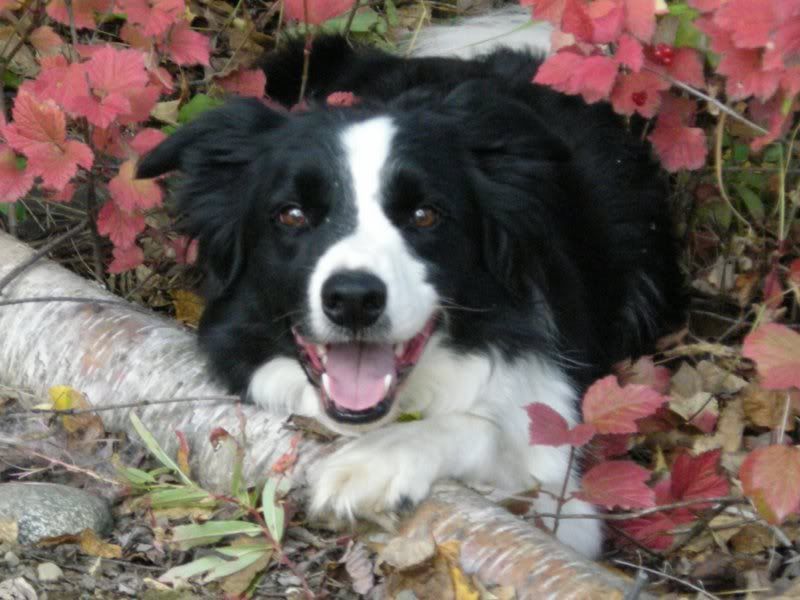
When it's the middle school, I usually take Finn; for some reason Kenzie is less comfortable in "big kid school", so I reserve her for the second-graders. Finn is an equal-opportunity ham, however, and happily goes wherever I take him, regardless of the age of the children.

I do the school programs in part because I enjoy them; in part because I try to do some community-minded volunteer-type stuff (after all, I get a great deal from this community, so I feel it's only right to give something back); and in part, I admit, because I live for the thank-you notes. I adore the thank-you notes. They're dear and funny and sweet, full of gratitude and charm. I admit I find the spelling and grammar errors endearingly amusing; this may be because I am myself an indifferent speller, and I can relate. (I am deeply grateful for spell-check for this reason, as well as because I'm an iffy typist and mildly dyslexic, to boot. And you should all be grateful for it, too, most especially as it seems NOT TO BE WORKING for this post, so you're going to have to suffer my deficiencies this time around. You poor things.)
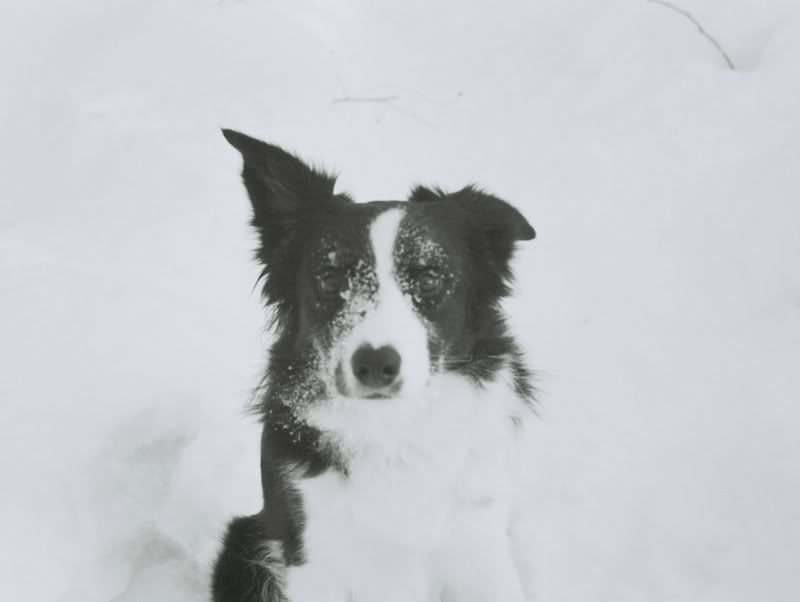
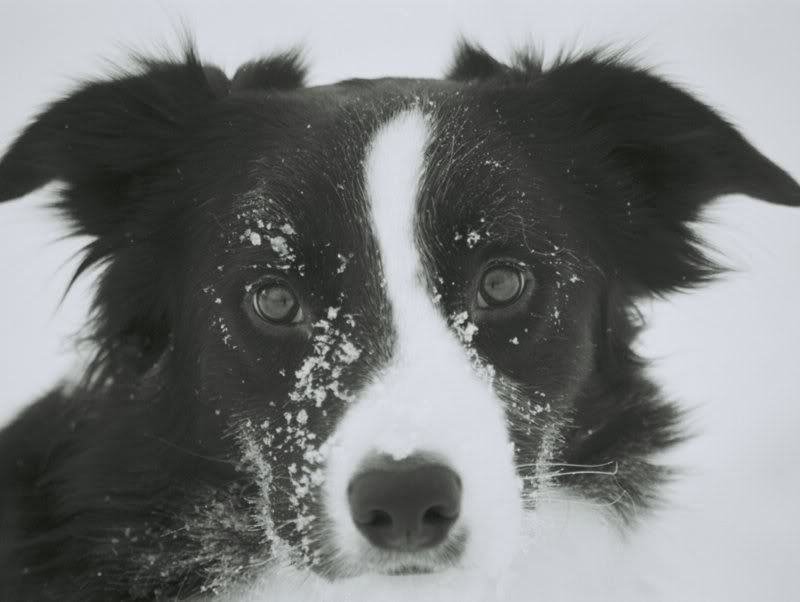
When it's the middle school, I usually take Finn; for some reason Kenzie is less comfortable in "big kid school", so I reserve her for the second-graders. Finn is an equal-opportunity ham, however, and happily goes wherever I take him, regardless of the age of the children.
Finn is also (in my 100% unbiased opinion) a very good-looking dog, and one who does not require grooming to look spiff (although in the photo above he's had his belly shaved for surgery - a story for another time.)
I do the school programs in part because I enjoy them; in part because I try to do some community-minded volunteer-type stuff (after all, I get a great deal from this community, so I feel it's only right to give something back); and in part, I admit, because I live for the thank-you notes. I adore the thank-you notes. They're dear and funny and sweet, full of gratitude and charm. I admit I find the spelling and grammar errors endearingly amusing; this may be because I am myself an indifferent speller, and I can relate. (I am deeply grateful for spell-check for this reason, as well as because I'm an iffy typist and mildly dyslexic, to boot. And you should all be grateful for it, too, most especially as it seems NOT TO BE WORKING for this post, so you're going to have to suffer my deficiencies this time around. You poor things.)
At any rate, after one such school program at one of the local middle schools, I received in due course and as usual a hefty packet of thank-you notes. There are two distinctly different piles, evidently reflecting the different tones of the two classes. I suspect (though there's probably no way to find out) that the more formal ones came from the class where the teacher reminded me of my high-school gym teacher... kind of blunt and direct and a little bit brusque, but sort of funny (to an adult, at least) as a result of her bluntness. She struck me as more of a disciplinarian and therefore perhaps less likely to encourage a lot of extra creativity in the students. The other group (wildly creative) I suspect to have come from the class taught by the sexy piratical guy, the one with the shaven head and the van dyke. Kind of an offbeat persona, which at least implies that he might encourage a more creative approach in the TY notes. But I could have that compeltely backwards, and there's no knowing.
Anyway, many of the notes came with drawings of dogs and cats and various other animals (some of the more ghoulish kids drawing several Frankenstein-esque gashes sutured with something heavy enough to tie down a small plane). One made a rather adorable little pop-up thank-you doggie inside, and a couple wrote my name in snakes or other animal shapes. One girl engineered her card (with staples) into the shape of a kite (although I initially took it for a paper airplane, til I opened it). And one enterprising lad wrote an entire poem to me (or maybe it's a commercial jingle). I'll try to hit the highlights (and despite my usual egregious typing, the spelling errors you are about to see are faithfully copied from the originals - mostly, at any rate)...
Dear, Dr.
I am listening to everybedy talk whale there supos to work. Now the teacher is talking. I listen when I am wrighting. [I rather like the introspective tone of this beginning.] I like the part when you told me what dog apered the most. Another part I like is the xray of the dog that ate the rocks. And how you get thame out. The job that I whoud whant is Chane Reactions. Chane Reactions is a julury stor whare you learn how to make beads, neckleses, braslets and shapes. [Presumably spelling isn't a big part of the job]. Thank you for telling me about vets and what they do. I hope I can see you ageane. I whish you where hear rigt now. [That's rather sweet, isn't it?] I whish you luck with the animals.
Dear Dr.
Thank you for coming to our class about your proffession. I thought that the little dog you brought in at the end was really cute. I thought some of those pictures of the dogs that had been hit by cars were perrty gross. [No photos - WAY too graphic. Instead, a couple of Xrays of broken legs, bladder stones, rock dogs, pregnant dogs, etc.] I think it would be interesting to work on a snow lepord. [This evidently in reference to me telling them about working on snow leopards (oops, I mean lepords), rhinos, bison, etc, at the Denver Zoo when I was a student].
Dear Dr.
Thank you for explaining your job to us. I enjoyed seeing the pictures of the animals with broken bones and diseases. [This must be one of the ghoulish ones]. I especially liked your dog, I didn't get to touch it so I hope you can bring him again.
Dear Dr.
I thought it was weird how one of the dogs swallowed about 10 rocks. I was the one who guessed it. [I put up the Xrays and ask the kids what they think that is... I'm not sure it teaches them a lot about what it is to be a vet, but they really like it.] I think that if you like having dogs as pets you should get a canarie island bird dog. They are really nice becuase they always listen and they are very loyal. [Okay, this is the first time I've gotten advice on what breed I should own while doing one of the school programs. Clearly this child knows something I don't, since I've never heard of a Canary Island Bird dog. And if there's any breed on earth that always listens, I'm eager to learn more.]
Dear Dr.
Thank you for caming in and talking to us about your job as being a veteranarian. I think ispired alot of people. I think that you did a good job. [Ahhhh, my first rave review of the batch. Always nice to know you've performed well.]
Dear Dr.
I liked your prformens it was good. The best part about your prformes is that I diden't know that dogs would eat rocks. But I thought that all of the exrays were cool. I thought that the dog that got shot in the head and diden't even know wus the cooest. [TRUST me the dog knew when he got shot in the head. Even the densest, goofiest American Bulldog will tend to notice a thing like THAT.] Well, I won't to thank you again for comming in Thanks.
Dear Dr.
Thank you for comeing in to my class. I had a cat that had a broken leg. Your friend, Jess [I suspect this is one of the 2 kids who didn't get to tell me about his pet's injury/illness/visit to the vet during my 25-minute visit, since approximately 27 of his little classmates were doing so all at the same time.]
Now we come to the 'creative' batch, most of which were folded like cards, and many of which featured color drawings exhibiting various degrees of talent for color, form and gore.
To: Dr.
Thank you! [accompanied by a drawing of a dog with several Bandaids stuck to its head, a long incision on the neck apparantly closed with 30# test line, and (judging by the angle) a dislocated shoulder.] Inside is written: I'm glad you came. You showed us some x-rays and thanks for answering my questions about British Bulldogs
sincirly, Rory [underneath which is drawn a very stiff-looking dog all in black except for the end of its nose and its eye, which are white. The reason for the strange coloration is apparant in the caption, which reads "Full body cast".]
[On the front] THANKS [with grass, flowers, a biiiig sun, and a dog and a cat both apparently levitating above the flowers.]
[Inside] Rank roo rery much! Dr. Petit [I believe this is the Scooby Doo entry.] I think your job cool and I wold like to look into the job more because you make it look FUN! [All in blazing color.]
[On the front a picture of a dog through a window, which at first I took to be a little Harry Potter wizard dog because it looked like it was wearing a pointy hat. On closer inspection, however, it proved to be a dog with THREE Bandaids (two crossed in an X), a long scary incision with more of the heavy nylon rope-type sutures, and a bandage tied around its forehead, above which protrude the pointy ears, evidently glued together into a spike, which is what I mistook for the hat.] Dear Doc
[Inside] I am so glad that you came in because after I've lived all my life with animals I want to become a vet. The first time I wanted to be a vet was when I helped my mom save a lamb when I was in the forth grade. [Accompanied by a drawing of a dog covered from head to toe in an intricate crosshatching of bandages that would do a mummy proud. The only things not covered by the wrap are the muzzle, the eye, and the ears - again appearing to be glued together into that darn spike.]
Dear Mrs. Dr.
Thank you for comeing to our class! My favoret part was the exray's. Some day I might become a vetinairian. [Along with a vividly colored portrait of what appears to be a dachshund approaching a bonsai tree, possibly to urinate on it, based on the pose... or perhaps this is the one child in the class who noticed that Finn tried to claim one little boy as his own by urinating on his shoe. (Yikes.)]
[On the front, along with a drawing of a long-necked something that looks quite a bit like a llama] Dear D Thank you for coming!
[Inside, along with another sketch which I take to be an animal of some description, since it has four legs and a head with long pointy ears] Dear D thanke you for coming to our class. I learned somethings. I never new that dogs can get elphaseaha. [??? I *think* he means emphysema, which is the only thing I can come up with that comes even close; although I don't recall mentioning emphysema to them, I certainly might have done. I did say "testicles", after all, so I might have lost my head completely and said practically anything.]
[On the front, along with a head-on view of a cat with a VERY large nose - unless it's a tumor - and a dog which appears to be plugged into some sort of electrical device capable of making all its fur stand on end, not to mention producing a distinct look of alarm on its Crayola'd face.]
Thank you Keith A.
[Inside] Thank you for coming. If I need my gerbil worked on, I'll come to you. In the meanwhile, be carefull and have a good time. Sincerly, Keith A. P.S.: When handleing needles, don't pook yourself. [Sage advice, which I give you my word I ty to follow daily.]
Thank You Dr. [On the front, along with drawings apparently erased but still visible, of a muscle man hanging from the "o" on "you" - rather nicely done, actually - and a tree with what appears to be an orangutan in it, perched in the branches above what is either a small rhino or a really big warthog.]
[Inside] I reely liked the fact you have don surdry on a monky. [Here he must be again referring to my stint at the Denver Zoo, unless he has somehow gotten wind of that unfortunate encounter with Mickey Dolens and Davy Jones...]
Dear Dr.
Thank you for coming. It is a delight that you take time off work for us. I really enjoyed when you showed us the ex-rays. I think you changed my mind about a doctor. I'm going to be a vet. [Accompanied by a rather adorable drawing of a dog, although he does have little stars in his eyes which make him look like someone just cold-cocked him.]
And the piece de resistance (I hope I can do this one justice...)
On the front are drawings of a snake with a biiiig bulge in the middle, an apparently sneezy cat with (I kid you not) a box of tissues in its paws (clearly labelled, with one popped up out of the top), a dog with a ferocious grimace on its face and what looks like a Robert Jones bandage on its back leg, and small aquarium with three smiling fish in it. My little artiste has written "Thank You Dr.!" At the bottom of the page he's signed it "From: Jake". Inside, it goes like this (and I am NOT making this up):
A PET TETE-A-TETE
If your cat is sick or your dog thinks he's a nick Call the VET!
If a snake swallows a ball or a pig takes a fall bring in your PET!
If your bunny is funny (hey, that's kind of punny) call the VET!
If your fish is almost a dish (while watchin' TV! (well, not the Omish!))[could he mean "The Comish"?] your pet's standards are MET!
Next to this is a hilarious picture of a snake (evidently the one that swallowed the ball, since it has a hugely distended middle) and a cartoon speech bubble saying "BURRRP!"
This was funny enough, but on re-reading it later for a second giggle, I happened to flip it over and on the back (where the Hallmark logo would be) he has written:
P.E.T.Z.
Protection Egenst (against) Total Ziffheads.
No animals were harmed in the making of this card.
I just howled. Partly I was pretty impressed with little Jake (whoever he might be - although I'm not at all certain what a Ziffhead is), and partly it reminded me of a card I made for my "little sib" in vet school.
There's s program in vet school where they assign all incoming freshmen a "big sib": an outgoing freshman who, having just finished the gruelling and scary first year is (one hopes) in a position to advise the new frosh about books, prof's, exams and so on. Traditionally, the big sib comes and leaves a card with words of encouragement or a small present on their little sib's desk just prior to the first exam, to loosen them up and give a little moral support before the scariest exam of first semester (and maybe of the entire program). On the morning of my first vet school exam, I got a card, a plateful of snickerdoodles, a new eraser, a new and freshly sharpened #2 pencil, and a petri dish full of M&Ms labelled (on lab tape) "M&M culture - eat on [whatever the exam date was]". I thought the M&M culture was a pretty good idea, so I shamelessly stole it for my little sibs (of which I had two). I also made little hand-drawn encouraging cards - a general one for the one I didn't know as well, but a more personal one for M, the sib I'd roomed with over the preceeding summer. I went to a bit more effort there since we were friends and she'd spent a lot of time with me AND my little vet-school sidekick dog, Merrik.
Inside her card I wrote something along the lines of, "You've worked. You've studied. You've come to recognise your classmates by smell alone. You are READY for this test. You can do this!" (and several other rah rah statements). On the back - unnoticed, I was told later, the first time around (shades of my go with Jake's card), I had drawn a picture of Merrik - a good likeness, if I say so myself, with her abundant curly/wiry terrier-mix fur and her big bat ears, and a pronounced squint on the right, where she'd lost the eye. Under this "logo" I wrote "HallMerrik: When you care enough to send the hairy pest." Evidently during the exam M was sitting and waiting for her turn at the microscope, killing time, so she idly picked up the card to read it again and just happened to flip it over. I gather she aspirated an unfortunate amount of coffee, and that some of her classmates were less than pleased to have her burst out laughing hysterically in the midst of the exam. Tight-asses.
So that's the best of the thank-you notes from that visit... but I assure you there are others, from other programs in other years and other schools. I'd like to say that they're from my little fans, but by far and away most of them are really from fans of my dogs. That seems fair; of the two of us - my dogs VS me - they really have the more difficult job; I get to live with them.... but they, poor things, have to live with me.
Subscribe to:
Posts (Atom)

 Posts
Posts

